Why it’s time to restart the federal immigrant-investor program
2019/04/01 Leave a comment
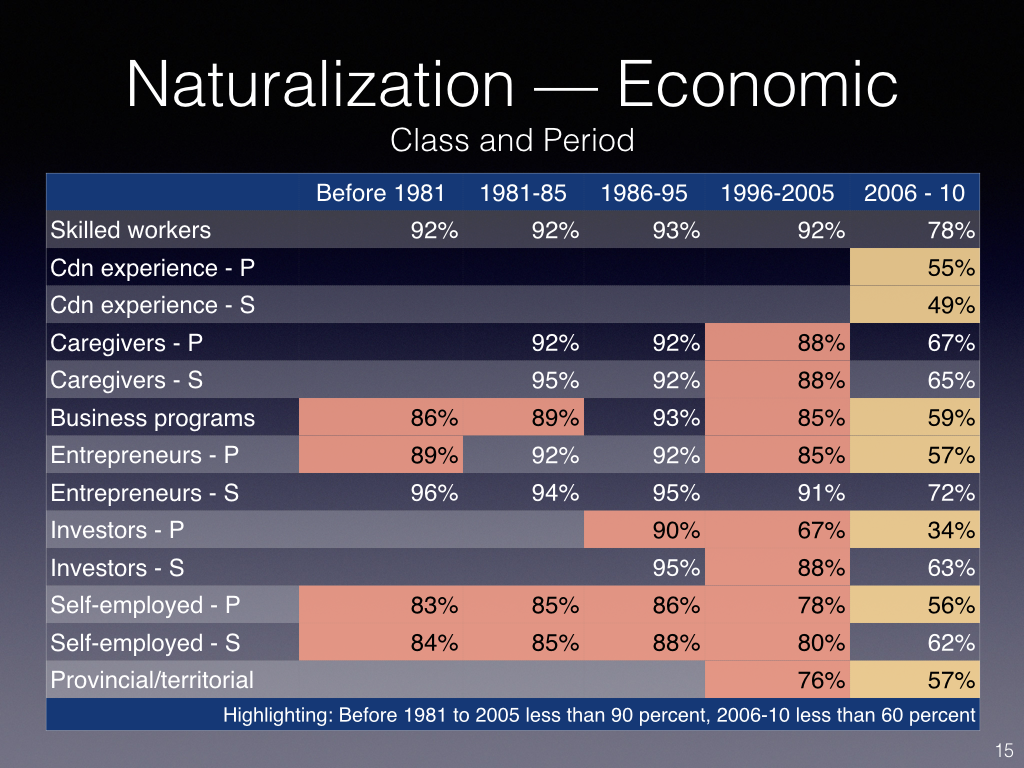 No, it’s not (apart from creating business for immigration lawyers, some increased pressures on the housing market and some increased consumer spending. It is striking when looking at Canadian immigration data, that the incomes of primary applicants under the previous investment programs, based on tax data, are less than refugees since 1996.
I have not been able to find a Quebec government evaluation of its investor immigrant program on their website so it is hard to substantiate or refute Silverstone’s claim that it has pumped “billions” into the Quebec economy. We do know, however, that most of these immigrants end up elsewhere and pay little to know tax (Opinion | Study reveals awfulness of Canadian investor immigration):
These are exhilarating times for Canadian immigration. Ottawa announced last December that it would be accepting more than one million immigrants over the next three years, with an increase in 2018 to 310,000 from the previous 300,000 annually, followed by a further increase to 330,000 in 2019 then to 340,000 in 2020.The Province of Quebec, which essentially runs its own immigrant selection process, is, however, reducing its intake by some 20 per cent.
The large majority of these new entrants to Canada will be in various economic categories. In particular, the federal government’s new global talent stream, with its quick-processing turnaround time, and enhancement of the startup visa program, are becoming very useful mechanisms for recruiting and retaining international high-tech talent.The express entry stream, which brings skilled workers to Canada, broke a record in 2018, with almost 90,000 invitations to apply issued. This represents an increase of nearly 4,000 over the previous record set in 2017. Immigration authorities are also promising to clear some of the backlog in the family-reunification class, including the families of the much-needed live-in caregivers. The rules for obtaining Canadian citizenship have also been significantly relaxed.
With the national unemployment rate at a 40-year low 5.6 per cent, immigration is on its way to being an ever-more significant factor satisfying the Canadian labour market. It’s the major factor in Canada’s population growth, which rose by about 1.4 per cent last year. About 71 per cent of this growth is as a result of immigration.
However, processing immigration applications as well as refugee claims does not come cheap. The 2018 federal budget supports increased immigration levels to the tune of $440-million, with an additional $173-million for asylum seekers. The government’s pre-election budget earmarked $1.18-billion over five years to “accelerate” the claims process and to “facilitate the removal of failed asylum claimants.”
Quebec’s immigrant investor program
Since its inception in 1986, the Quebec immigrant investor program has pumped billions of dollars into the Quebec economy. Quebec’s is a passive investment program. This means that potential immigrants must ante up $1.2-million for a period of five years, after which the money is returned in full but without interest. The prospective investor must establish a minimum personal net worth of $2-million and be able to demonstrate the legal provenance of the funds. They also have to be able to show at least two years of business management experience. The vast majority of the thousands of immigrant investors come from China and elsewhere in Asia, with some from the Middle East. Quebec charges a substantial application fee. The program is well run and has proved to be an economic winner.
Although the program is administered by the province, investors and their families must satisfy federal security and medical standards. One of the criticisms is that the bulk of successful applicants do not maintain their residence in Quebec, but rather flow to other parts of Canada, primarily southern Ontario and British Columbia. Quebec has responded to this by adding an intent to reside in the province proviso, but, in practice, inter-provincial mobility will really not be restricted.
Restarting the federal investor program
Canada’s federal immigrant investor program was terminated in 2014. It is time for it to be restarted. An immigrant investor program geared toward job creation in economically challenged areas of the country should be implemented now. Such a program could require an active investment of $1-million, with perhaps a lower amount geared toward areas of higher unemployment. This money would be risk capital directed toward private-sector enterprises with job creation as an essential component. The Canadian stream should, of course, include all necessary checks to ensure the legitimate source of the funds as well as to determine the net worth of the applicant.
Borrowing from the EB-5 conditional-visa system in the United States, the Canadian plan should provide for the creation of regional centres, which would enable the private sector in any given area to participate constructively in the allocation of the investment by the foreign applicant. Regional centres in the U.S. bring together investors and local and regional entrepreneurs and economic development officials to ensure the best use of funds. Studies have found that, in the U.S., immigrant investor capital has played a key role in financing several large projects in areas as diverse as New York and Las Vegas.
In the Canadian context, the regional centre would always have as its focus the creation of at least two permanent jobs per investor. Substantial application fees and a security deposit, along with strict monitoring of the investment, will keep away tire kickers and fraudsters, and the regional centre must be prepared to provide complete transparency with regard to the investment process and allocation of resources. In addition, it should be tasked with assisting the immigrant investor as well as other classes of immigration, including refugees, by providing integration and employment services in order to ensure that newcomers build successful lives in this country. Refugees could be major beneficiaries of the job-creation component of a rejuvenated immigration investor program.
Alternatively, the government could just reinstate the discontinued federal immigrant investor program as it was, basically mimicking Quebec’s passive investment initiative. Either way, an essential element that would maximize chances for success would be a firm undertaking by the federal government that applications would be handled in a timely fashion. Serious overseas investors are not going to wait four and five years to have their applications processed.
A typical immigrant investor arriving with a family in a struggling area of the country will be serious and motivated. The investor, having paid perhaps $30,00 in application fees, along with a risk capital investment of a million dollars—and spending perhaps nearly that amount again in dwelling costs, clothing, schooling, vehicles, and many other needed expenditures—will surely be an asset rooted in his or her chosen community. This, combined with the establishment of a viable commercial enterprise and the creation of employment opportunities, produces a winning situation that could economically and socially boost many Canadian locales, especially those outside Montreal, Toronto, and Vancouver—that attract the bulk of new immigrants.
Ramping up to receiving 10,000 families annually could generate billions and create 20,000 jobs. Now is the time to act and get new money into our system before we lose more highly desirable investor immigrants to other jurisdictions.
Source: Why it’s time to restart the federal immigrant-investor program
 About Andrew
 Multicultural Meanderings