Immigrant kids in U.S. deliberately build STEM skills


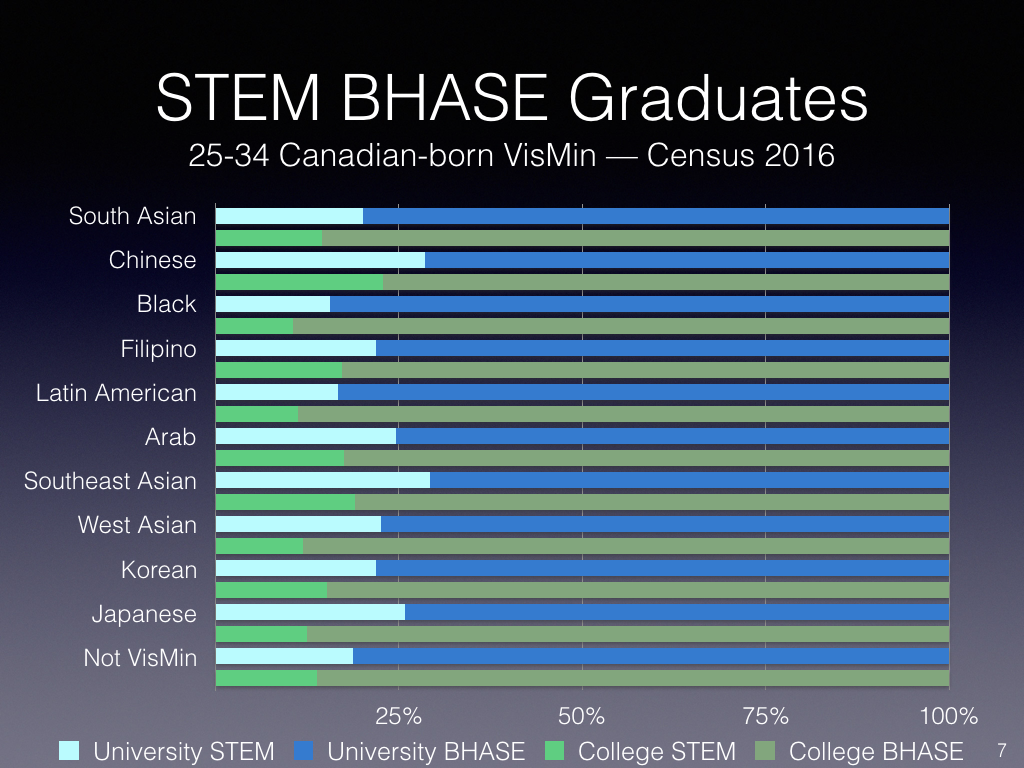
Similar pattern in Canada (chart above looks at Canadian-born visible minority university and college graduates compared to Not VisMin):

U.S. immigrant children study more math and science in high school and college, which leads to their greater presence in STEM careers, according to new findings from scholars at Duke University and Stanford University.

“Most studies on the assimilation of immigrants focus on the language disadvantage of non-English-speaking immigrants,” said Marcos Rangel, assistant professor at Duke’s Sanford School of Public Policy. “We focus instead on the comparative strength certain immigrant children develop in numerical subjects, and how that leads to majoring in STEM subjects in college.”

About 20 percent of U.S.-born college students major in STEM subjects. Yet those numbers are much higher among immigrants — particularly among who arrive the U.S. after age 10, and who come from countries whose native languages are dissimilar to English, Rangel said. Within that group, 36 percent major in STEM subjects.

“Some children who immigrate to the U.S., particularly older children from a country where the main language is very dissimilar to English, quite rationally decide to build on skills they are relatively more comfortable with, such as math and science,” said Rangel.

Those older immigrant children take more math and science courses in high school, the authors found. Immigrant children arriving after age 10 earn approximately 20 percent more credits in math-intensive courses than they do in English-intensive courses.

This focus continues in college, where immigrant children are more likely to pursue science, technology, engineering and math majors. Those majors, in turn, lead to careers in STEM fields. Previous research has shown that immigrants are more highly represented in many STEM careers.

“Meaningful differences in skill accumulation … shape the consequent contributions of childhood immigrants to the educated labor force,” the authors write.

Source: Immigrant kids in U.S. deliberately build STEM skills

Fact-checking immigration: Boustan uses big data to explore myths about the past

Some interesting work here:

“When the horns started to blow and we saw the Statue of Liberty, I thought I was in heaven. Really. She’s up there and saying, ‘Come on in. From now on you are a free person.’”

These are the words of Turkish immigrant John Alabilikian, who came to the United States in 1922, collected by the Ellis Island Foundation in 1985 as part of its oral history library. In his interview, Alabilikian described escaping the Armenian genocide and journeying to America.

Personal anecdotes like these serve as a rich source of data for economist Leah Platt Boustan, who brings modern statistical analysis and big-data tools to the study of historical events and trends. With the recent digitization of first-person accounts and other documents, Boustan can uncover insights from people’s personal experiences in ways previously not possible. “It’s almost as if we can conduct surveys of people who lived in the past,” she said.

Statue of Liberty with quote from Leah Boustan, Professor of Economics; “Many people imagine that [19th-century] immigrants from Europe very quickly climbed the economic ladder and adopted U.S. behavior norms, and that immigrants today are slower to do so. That’s not the case.”

Boustan, who joined Princeton as a professor of economics in 2017, has an impressive record of proving and disproving ideas that people believe based on anecdotes or “gut feelings.” In the past, economists and historians had few data tools, but with today’s powerful computers and mathematical approaches, historical perspectives can be tested against hard numbers.

“Often what we think we know, we don’t really know,” Boustan said. “If you start to introspect, and ask, ‘Where do my beliefs come from?’ you might realize they come from your family’s experience or from relatively few anecdotes. We rarely test our beliefs with thousands of cases.” Boustan tries to rediscover that lost nuance, giving economists and historians a statistical footing for their research.

One of the questions Boustan has tackled is the issue of “white flight.” Between 1940 and 1970, white Americans left cities in large numbers, but historians have debated whether this exodus was motivated by the desire to pursue opportunities in suburbs or because of an influx of black Americans. Boustan’s analysis, published in the Quarterly Journal of Economics in 2010 when she was on the faculty at the University of California-Los Angeles, suggests that both were true.

Another of Boustan’s recent projects is on the age of mass migration, a period from around 1850 to about 1920, when more than 30 million Europeans moved to the United States. Working with longtime collaborators Ran Abramitzky at Stanford University and Katherine Eriksson at the University of California-Davis, and with support from the National Science Foundation, Boustan compared historical data to today’s records, asking: Are immigrants today assimilating more slowly than they did in the past?

“Many people imagine that immigrants from Europe very quickly climbed the economic ladder and adopted U.S. behavior norms, and that immigrants today are slower to do so,” Boustan said. “That’s not the case.”

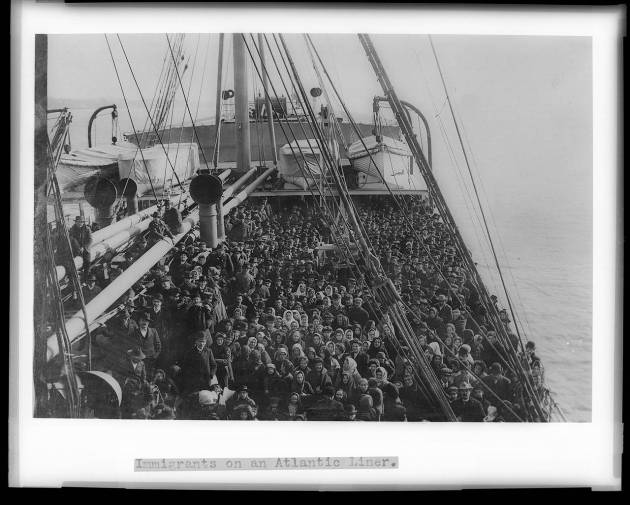
Crowds on 19th century immigrant ships

Leah Boustan, professor of economics, uses digitized historical records and other sources — like this 1906 photograph of immigrants on an Atlantic liner — to give researchers a statistical footing for studies on immigration, past and present.

Prior work suggested that European immigrants during the age of mass migration were paid less than native-born workers upon first arrival, but then quickly caught up. Boustan and her collaborators tracked the occupations of 21,000 natives and immigrants over two decades, and, in work published in 2014 in the Journal of Political Economy, showed that this common wisdom does not fit the facts in two different ways. Many recently arrived immigrant groups did not have lower earnings than natives and, overall, the income of immigrants and natives rose at close to the same rate.

Slow rates of economic assimilation are consistent with the experiences of recent immigrants, according to studies by other researchers, Boustan said. “There is nothing special — or necessarily alarming — about economic convergence that takes more than one generation,” Boustan said. “We have been there before.”

One measure of cultural assimilation that Boustan looked at was how immigrants named their children. Because selecting a child’s name costs nothing, and thus is independent of socio-economic status, Boustan argued that names indicate a family’s eagerness to adopt American culture. In work supported by a grant from the Russell Sage Foundation, she and her colleagues used millions of entries from recently digitized census records to calculate a “foreignness index” for each name in the early 1900s. She conducted a similar exercise using birth certificate records from California today. In both cases, she found that immigrants shift away from foreign-sounding names as they spend more time in their adopted nation, and at the same rate.

“What was striking about those two sets of analyses — the past and present — is that the speed of cultural assimilation, by this measure, is almost identical in the past and present,” Boustan said. The study is detailed in an NBER Working Paper posted in July 2016.

Boustan’s work is part of a growing trend in economics toward harnessing large data sets to explain historical observations, said her colleague and former mentor, Henry Farber, Princeton’s Hughes-Rogers Professor of Economics. Farber met Boustan when she was an undergraduate at Princeton in the late 1990s. Boustan later earned a Ph.D. at Harvard University in 2006 and then became a professor at the University of California-Los Angeles.

Today, Boustan’s office is only a few doors down from Farber, who is next door to his own dissertation adviser, Orley Ashenfelter, the Joseph Douglas Green 1895 Professor of Economics — three generations of empirical economics in one hallway. “Princeton is lucky to have her on the faculty,” Farber said.

Boustan is also part of the trend toward increasing female participation in a historically male-dominated discipline. When a leading journal recently asked her how the field might attract and train more women, she was caught off guard. “I realized that I didn’t know much about the overall situation of women in economics — I only knew anecdotes from my personal experiences,” Boustan said.

So she began investigating the problem with her characteristic big-data approach. “It is a very important question, and the best way to work on big questions is to take a look at the data,” she said.

She paired with graduate student Andrew Langan to collect data on the male-female graduate student ratios in economics departments at leading research universities and learn more about why some programs have more success than others in training women. Graduate programs in economics are on average 30 percent female across the nation, with some as low as 10 percent female and others achieving a 50-50 balance, Boustan and her team found.

“The average picture looks gloomy, but there are some bright rays,” Boustan said. For example, even departments with high numbers of male students and faculty can serve female students well if they provide opportunities for training and mentoring, they found.

Boustan keeps this in mind as she mentors and advises students in Princeton’s economics department. One advisee, Ji Won Choi, said, “I hope I can be an example, like Leah, for others in the future.”

Until recently, Princeton’s Department of Economics had few women in senior faculty positions, but the department has doubled its number of female faculty members over the past four years, said Janet Currie, the Henry Putnam Professor of Economics and Public Affairs at the Woodrow Wilson School, who was department chair until June 2018. “Nevertheless,” Currie said, “we are not where we would like to be, and we’ll need continuous effort not to lose the gains we have made and to diversify the faculty and student body in other dimensions.”

With so many charged topics facing society today, from the equitable treatment of women in the workplace to the role of immigrants in building the nation, Boustan’s data-driven approach to controversial issues is more relevant than ever. To explain the importance of this work, Boustan quotes her former mentor, the Harvard economic historian and labor economist Claudia Goldin: “The best historical questions are the ones that speak to the world we live in today.”

Source: Fact-checking immigration: Boustan uses big data to explore myths about the past

ICYMI – Chris Selley: Police carding ought to be an anathema in a free society. How is it still up for debate?

Good commentary:

In the debate over if, when and how police should be able to stop, question and compel identification from citizens, and then store the information they receive in databases, those arguing to allow officers maximum discretion tend to defer to public safety. The more info police have, the more crime and violence and misery they can avert. Conveniently for that view, in the two years since more restrictive rules took effect in Ontario, Toronto has experienced a significant spike in homicides.

Coincidence? Justice Michael Tulloch thinks so. In his 300-page report on the Independent Street Checks Review he oversaw, officially released Friday, Tulloch does a pretty good job busting causation down to correlation.

In 2013, he observes, Toronto police agreed to ramp down “street checks” (an interaction producing “identifying information … concerning an individual … that is not part of an investigation”) and “carding” (when “a police officer randomly asks an individual to provide identifying information when there is no objectively suspicious activity,” and the individual isn’t suspected of or to have knowledge of any offence, and the information winds up stored in a database).

Despite that, the city’s homicide count held steady at 57-59 per annum until 2016, when it spiked to 75. In 2017, the year the rules came fully into effect, the number dropped to 65, before soaring to 96 in 2018 — the highest in a decade.

The number of shooting incidents, meanwhile, has hardly budged since the new rules came into force: There were 406 in 2016, 390 in 2017 and 424 in 2018. Furthermore, some areas of the city where carding was most prevalent — Jane and Finch, Rexdale, Lawrence Heights — saw dramatic decreases in shooting incidents. Whereas getting guns off the street is a common justification for intrusive police tactics, such as New York City’s stop-question-and-frisk, firearm seizures in Toronto skyrocketed after the new regulations came into place. And other Ontario municipalities reported no similar surges in crime. Overall, homicides in Ontario dropped from 2016 to 2017.

In short, it’s far easier to make a case that carding has no effect at all on serious crime than that it has a huge one. But even if previous carding practice had “worked,” even if the new regulation had stopped it from working, it barely even amounts to a defence. As Tulloch notes, “the regulation simply gives effect to the existing law that people do not have to provide their identification when there are no reasonable grounds to believe the person has committed an offence.”

If carding “worked,” in other words, it relied on citizens not knowing or caring about their already-existing right to be left alone whilst minding their own business, or being too intimidated to exercise that right — as well they might be. Politely refusing an armed man or woman’s request to identify yourself is no small thing, all the more so if you have “nothing to hide.”

The problems inherent in such a situation are myriad. There are quantifiable harms: People were denied jobs and security clearances, and in at least one case menaced by child services, thanks to information stored in police databases that implicated them in nothing other than being included in a police database. And there are more existential harms. Imagine growing up with a squeaky-clean nose yet constantly feeling like a person of police interest. It’s profoundly alienating, especially when targets quite logically conclude, based on well-documented statistics if not their own intuition, that they’re being harassed because of their race, skin colour or some other innate characteristic. It’s no less insidious if the bias is unconscious; it might even be more so.

Nothing good can come from it, and plenty bad. It hinders police in solving crimes, for one thing: “When a segment of society believes that it has been unfairly targeted by the police,” Tulloch writes, “it will delegitimize the police in their eyes.” All those desperate calls for witnesses to come forward will be met more skeptically. Tulloch cites research showing “inappropriate interaction with police” can even “desensitize young people from guilt regarding potential acts of crime.”

Tulloch has scores of recommendations, including clarifying what he argues are overly complex rules for officers; requiring officers to tell people when a conversation is voluntary; including written reasons for the existence of any database record; and destroying those records automatically after five years.

As he says, the police have lots of powers at their disposal — including the power to stop and question people if officers have a legitimate, articulable “reason to believe the identifying information would be valuable police intelligence.” That still goes too far for some civil libertarians. But it’s maddening there are still people who object to the very idea of eliminating truly random stop-and-question policies; people who can’t grasp just how anathema that idea ought to be in a free society, how profoundly it undermines the social contract that underpins modern Western policing; people who could actually take issue with Tulloch’s most fundamental recommendation: “No police service should randomly stop people in order to collect and record identifying information and create a database for general intelligence purposes.”

Well, obviously.

Source: Chris Selley: Police carding ought to be an anathema in a free society. How is it still up for debate?

John Ivison: Trudeau sounds resigned to his inability to solve Canada’s border-crosser problem

Interesting and nuanced commentary, including recognition by the Prime Minister in terms of the limitations:

Justin Trudeau appears to have given up hope of reducing the flow of people crossing from the United States illegally to claim asylum, and is test-driving fresh rationalizations on why a migrant surge might not be such a bad thing. The new line from the Prime Minister is that the flow of asylum seekers may prove an economic boon for Canada.

“The fact that we have extremely low unemployment, we’re seeing labour shortages in certain parts of the country, (means) it is a good time to reflect that we are bringing in immigrants who are going to keep our economy growing,” Trudeau said in a pre-Christmas interview.

The statement came in response to a question about a contention by his predecessor, Stephen Harper, that an immigration system that is legal, secure and economically driven will have high levels of public acceptance, while the “irregular” migration phenomenon has made the system less secure and less economically driven.

It is clear there are labour shortages. A Business Development Bank of Canada study in September found four in 10 small- and medium-sized companies struggling to find new employees. But an orderly immigration system aims to match the skills of newcomers with the demands of employers. The free-for-all at the border is a triage situation. The only thing economically driven about it is the desire of the migrants crossing illegally to have a higher standard of living than they had in their country of origin.

Who can blame them? But it’s no way to run a country.

To claim this abuse of process will help the economy to grow is the latest attempt by the Trudeau government to justify its loss of control over the Canada-U.S. border. In November, Bill Blair, the border security minister, tried to sanitize the situation by pointing out that 40 per cent of migrants crossing illegally are children, suggesting that Canada is merely living up to its human rights obligations.

Neither argument can rationalize a situation where the integrity of the immigration system is being violated.

Trudeau pointed out that the Liberals have injected extra resources ($173 million in budget 2018) to ensure that everyone who arrives in Canada, even if they cross between official border crossings, is given a full security screening. “There are no loopholes or shortcuts, in that our immigration system continues to apply to everyone who arrives in this country,” he said.

This is true. The flow of migrants, mainly from Nigeria and Haiti, is costing the federal government a pretty penny — $340 million for the cohort of migrants who arrived in Canada in 2017, according to a November report by the Parliamentary Budget Office — not to mention straining provincial resources (the PBO estimated a cost of $200 million each for Ontario and Quebec). Such generous provision has attracted yet more asylum shoppers — year-over-year numbers suggest more people crossed illegally into Canada between January and September this year (15,726) than in the same period last year (15,102).

The endless appeals process means there is a massive backlog that is likely to require reform to reduce.

But at least the government has some control over the process once migrants have claimed asylum. When it comes to reducing the number flowing across the border, the Liberals appear accepting of their impotence.

Blair’s mandate letter gave him the lead role in talking to the Trump administration about “modernizing” the Safe Third Country Agreement, which states migrants claiming refugee status must make their claim in the first “safe” country they arrive in — Canada or the U.S.

A family from Haiti approach a tent in Saint-Bernard-de-Lacolle, Quebec, stationed by Royal Canadian Mounted Police, as they haul their luggage down Roxham Road in Champlain, N.Y., Monday, Aug. 7, 2017.

A loophole in the pact with the Americans means it does not apply between official points of entry.

But there appears to have been little progress on closing the loophole since public safety minister Ralph Goodale met then-homeland security secretary John Kelly in March, when they agreed to “monitor the situation” at the land border. Blair visited Washington in November to meet homeland security officials and his office says talks are “ongoing.”

They are likely to remain so.

No matter how much money the government spends trying to process asylum claims, a solution requires cooperation from the Trump administration — and that has not been forthcoming.

Even under Obama, there was no interest in extending the Safe Third Country Agreement to anyone crossing from the U.S. — a move that would increase the number of asylum claimants south of the border. There is likely to be a similar lack of concurrence about joint border enforcement patrols to stop people crossing in the first place.

But the agreement is currently as useless as a pulled tooth. There can be few issues of greater importance in the cross-border relationship and the point should be made forcefully in Washington whenever the Americans want something.

Canada’s consensus on immigration is in jeopardy, as economic migrants ignore this country’s laws and its borders.

Trudeau sounds resigned to being bound in an insoluble quandary. The upshot is that he is trying to promote an uncontrolled migration system as one that is not only orderly, but is of net benefit to Canada.

It is going to be a tough sell.

Source: John Ivison: Trudeau sounds resigned to his inability to solve Canada’s border-crosser problem

Faith on the Hill: The religious composition of the 116th Congress

Typically thorough and interesting Pew Research study (US numbers cited are House only).

By way of comparison, Canada has 6 Jewish MPs (1.8 percent compared to 6 percent), 11 Muslim MPs (3.3 percent compared to 0.7 percent), 20 Sikh MPs (5.9 percent compared to none:

The new, 116th Congress includes the first two Muslim women ever to serve in the House of Representatives, and is, overall, slightly more religiously diverse than the prior Congress.1

There has been a 3-percentage-point decline in the share of members of Congress who identify as Christian – in the 115th Congress, 91% of members were Christian, while in the 116th, 88% are Christian. There are also four more Jewish members, one additional Muslim and one more Unitarian Universalist in the new Congress – as well as eight more members who decline to state their religious affiliation (or lack thereof).

While the number of self-identified Christians in Congress has ticked down, Christians as a whole – and especially Protestants and Catholics – are still overrepresented in proportion to their share in the general public. Indeed, the religious makeup of the new, 116th Congress is very different from that of the United States population.

Within Protestantism, certain groups are particularly numerous in the new Congress, including Methodists, Anglicans/Episcopalians, Presbyterians and Lutherans. Additionally, Protestants in the “unspecified/other” category make up just 5% of the U.S. public, but 15% of Congress.2 By contrast, some other Protestant groups are underrepresented, including Pentecostals (5% of the U.S. public vs. 0.4% of Congress).

But by far the largest difference between the U.S. public and Congress is in the share who are unaffiliated with a religious group. In the general public, 23% say they are atheist, agnostic or “nothing in particular.” In Congress, just one person – Sen. Kyrsten Sinema, D-Ariz., who was recently elected to the Senate after three terms in the House – says she is religiously unaffiliated, making the share of “nones” in Congress 0.2%.

When asked about their religious affiliation, a growing number of members of Congress decline to specify (categorized as “don’t know/refused”). This group – all Democrats – numbers 18, or 3% of Congress, up from 10 members (2%) in the 115th Congress. Their reasons for this decision may vary. But one member in this category, Rep. Jared Huffman, D-Calif., announced in 2017 that he identifies as a humanist and says he is not sure God exists. Huffman remains categorized as “don’t know/refused” because he declined to state his religious identity in the CQ Roll Call questionnaire used to collect data for this report.3

These are some of the findings from an analysis by Pew Research Center of CQ Roll Call data on the religious affiliations of members of Congress, gathered through questionnaires and follow-up phone calls to members’ and candidates’ offices.4 The CQ questionnaire asks members what religious group, if any, they belong to. It does not attempt to measure their religious beliefs or practices. The Pew Research Center analysis compares the religious affiliations of members of Congress with the Center’s survey data on the U.S. public.5

The religious makeup of the 116th Congress


Religious makeup of new Congress similar to that of previous class

Percentage of Christians in Congress down slightlyWhile the overall composition of the new Congress is similar to that of the previous Congress – roughly nine-in-ten members of each identified as Christian – the 116th Congress has 14 fewer Christians than the 115th, and 20 fewer Christians than the 114th Congress (2015-2016).

Anglicans/Episcopalians and Presbyterians experienced the largest losses in the 116th Congress, which has nine fewer members in each of these groups compared with the previous Congress. Methodists, Congregationalists, Restorationists and Christian Scientists also lost at least one seat; there are no longer any Christian Scientists in Congress.

Some Protestant denominational families now have more members in the new Congress, led by those in the “unspecified/other” category, which gained 16 seats, bringing the total number in this category to 80. Among members of Congress, “unspecified/other” Protestants include those who say they are Christian, evangelical Christian, evangelical Protestant or Protestant, without specifying a denomination. By contrast, nondenominational Protestants, who also gained two seats (going from eight to 10), are Christians who specifically describe themselves as nondenominational.

There are five fewer Catholics and three fewer Mormons in the new Congress. There has been no change in the number of Orthodox Christians (five seats in both the new and prior Congress).

Among non-Christians, four additional Jewish members bring the Jewish share of the new Congress to 6% – three times the share of Jews in the general public (2%). Additionally, Unitarian Universalists gained one seat.

Muslim women join the new Congress for the first time – Michigan Democrat Rashida Tlaib and Minnesota Democrat Ilhan Omar. They join Andre Carson, a Muslim Democrat from Indiana, in the House, bringing the number of Muslims in the new Congress to three – one more than in the 115th Congress. (Omar represents Minnesota’s 5th district – replacing Keith Ellison, who was the first Muslim elected to Congress in 2006.)

The number of Hindus in Congress is holding steady at three. All of the Hindus from the 115th Congress are returning for the 116th: Rep. Ro Khanna, D-Calif.; Rep. Raja Krishnamoorthi, D-Ill.; and Rep. Tulsi Gabbard, D-Hawaii.

The number of Buddhists in Congress has dropped by one. Colleen Hanabusa, D-Hawaii, decided to run for governor in Hawaii rather than seek re-election in the House. (She was ultimately unsuccessful in her gubernatorial campaign.) Georgia Democratic Rep. Hank Johnson and Hawaii Democratic Sen. Mazie K. Hirono, both Buddhist members of the previous Congress, are returning for the 116th.

Sinema remains the sole member of Congress who publicly identifies as religiously unaffiliated, although there has been an increase of eight members in the “don’t know/refused” category.

Differences by chamber

Large gaps between chambers of Congress in shares of Presbyterians, CatholicsChristians make up large majorities in both chambers. In fact, Protestants alone form majorities in both the House (54%) and the Senate (60%). For the most part, there are only modest differences between the chambers within the Protestant denominational families, except when it comes to Presbyterians: There are 13 Presbyterians in each chamber, making up 13% of the Senate and just 3% of the House.

By contrast, Catholics make up a larger share of the lower chamber than the upper chamber: There are 141 Catholics in the House (32%) and 22 in the Senate (22%).

The Senate gains its first member to identify as religiously unaffiliated: Sen. Kyrsten Sinema, D-Ariz., joins the Senate from the House, where she was the first unaffiliated member in that chamber.6

All of the Hindus and Muslims (three each) are in the House, along with both Unitarians. The two Buddhists in the 116th are split between the chambers. Jewish members make up a slightly larger proportion of the Senate than the House (8% vs. 6%).

The number of members who prefer not to specify a religious affiliation doubled in the House between the 115th Congress and the 116th – they now number 14. In the Senate, there are four members who do not specify a religion, up from three who said this in the previous Congress.

Differences by party

GOP members of Congress almost all ChristiansIn the 116th Congress, just two of the 252 GOP members do not identify as Christian: Reps. Lee Zeldin, R-N.Y., and David Kustoff, R-Tenn., are Jewish.7

By contrast, 61 of the 282 Democrats do not identify as Christian. More than half of the 61 are Jewish (32), and 18 decline to specify a religious affiliation. Congressional Democrats also include Hindus (3), Muslims (3), Buddhists (2), Unitarian Universalists (2) and one religiously unaffiliated member. 8

Christians remain overrepresented in both parties’ congressional delegations compared with their coalitions in the general public. While 78% of Democrats in Congress identify as Christians, among registered voters in the broader U.S. adult population, the share of Democrats and those who lean toward the Democratic Party who identify as Christians is just 57%.9

Among Republicans and those who lean toward the Republican Party in the general public, 82% of registered voters are Christians, compared with about 99% of Republicans in Congress. Put another way, 18% of Republican voters are not Christian, which stands in stark contrast to the 0.8% of congressional Republicans who are not Christian.

Republican members of Congress are more likely than Democratic members to identify as Protestants (70% vs. 41%). Democrats in Congress, by contrast, are more likely to be Catholic – 35% of congressional Democrats are Catholic, compared with 25% of Republicans in Congress.

There has been a rapid shift in the partisan composition of Catholics in the House. In the 114th Congress (2015-2016), the numbers of Catholic Democrats and Catholic Republicansin the House were almost identical (68 vs. 69), and the figures remained similar in the 115th Congress (74 Catholic Democrats vs. 70 Catholic Republicans in the House). But the new Congress has 33 more Catholic Democrats than Catholic Republicans in the House (87 vs. 54).

First-time members

About eight-in-ten new members of Congress are ChristiansThe new, 116th Congress has the largest freshman class since 2011 – 97 new members join 437 incumbents.10

Of the new members, fully 81% identify as Christians. While this is lower than the Christian share of incumbents, it is still higher than the share of U.S. adults who are Christian (71%).

About half of freshmen are Protestants (49%), and three-in-ten are Catholic (30%). Among the Protestants in the freshman class, 23% are in the “unspecified/other” Protestant category. Rounding out the Christian freshmen are two Mormons (Democratic Rep. Ben McAdams and Republican Sen. Mitt Romney, both of Utah) and one Orthodox Christian (Rep. Chris Pappas, D-N.H.).

Among the newcomers, there also are seven Jewish members and eight who prefer not to specify their religion, as well as two Muslims and an unaffiliated member (Sinema is counted as a freshman because she is moving from the House to the Senate).

Looking back

Over the 11 congresses for which Pew Research Center has data, the 116th has the lowest number of both Christians (471) and Protestants (293). The 116th Congress also has the fewest Mormon members in at least a decade – members of the Church of Jesus Christ of Latter-day Saints now number 10, a low over the last six congresses.

Catholics have held steady at 31% over the last four congresses, although there are now many more Catholics in Congress than there were in the first Congress for which Pew Research Center has data (19% in the 87th Congress, which began in 1961). The share of Jewish members also has increased markedly since the early ’60s.
Source: Religious affiliation of the 116th Congress | Pew Research Centerwww.pewforum.org/2019/01/03/faith-on-the-hill-116/

ICYMI: Harper’s dissatisfied public servant more myth than reality, new research shows

Interesting study, using the Public Service Employee surveys that include all government core public administration employees (core public administration and participating agencies: Participating departments and agencies).

The strength of this study lies in its coverage of all employees, but the weakness lies in that it aggregates all their views together (at least based on this article) rather than breaking them down by employee group, organization etc.

A more interesting article would be to contrast the survey results of executives, generally with more exposure to the political level, and other employees, with less, along with departmental comparisons broken down similarly:

The portrait of the disgruntled public servant, beaten down by a poisonous workplace culture and years of disregard under Stephen Harper’s Conservative government is oft-painted — and, generally speaking, pretty inaccurate, according to a research article published Dec. 17 in Public Personnel Management, an academic journal for human resource and public sector executives.

While job satisfaction among federal bureaucrats decreased slightly during Harper’s time as prime minister, it remained “quite high” overall, writes Jocelyn McGrandle, the article’s author and a PhD candidate at Concordia University. McGrandle based her findings on data from the federal government’s 2008, 2011 and 2014 Public Service Employee Surveys.

“Over the past five years in the Canadian political landscape, there have been numerous calls for rejuvenating the federal public service due to toxic work cultures and a general disrespect for public servants,” McGrandle wrote. “Much of this was directed at the Conservative government under Stephen Harper.”

So strong was this outrage that the Public Service Alliance of Canada rolled out an anti-Harper campaign prior to the 2015 federal election, McGrandle pointed out. Then-Liberal leader Justin Trudeau also penned a letter to public servants promising a new era of trust and respect for the bureaucracy, if elected.

And let’s not forget “Harperman,” the 2015 protest song crafted by Environment Canada scientist Tony Turner that called for Harper’s ousting and led to Turner’s suspension from his job.

“2015 was such an interesting election with the public service very clearly coming out, not in favour of a particular party, but certainly against one party,” said McGrandle in an interview, when asked to explain her desire to research this particular topic. “That was sort of my puzzle: Is the public service that dissatisfied? Or is this a bit of political posturing?”

Having analyzed the data, she’s inclined to believe the latter.

“Much of the lack of satisfaction seems to be mostly political rhetoric,” McGrandle concludes in her article. While overall job satisfaction — ranked by survey respondents in the public service on a five-point scale — declined from an average of 4.14 to 4.05 between 2008 and 2014, “satisfaction, even at its lowest point in 2014, still remains relatively high.”

The significance of this finding goes beyond debunking a popular political mythology, according to McGrandle. It also underscores the importance of surveys like the triennial PSE survey, which the government committed to conducting more frequently starting in 2018.

“These employee surveys … can be used to measure how public servants actually feel, not how they are told they should feel during the course of an election.”

Paul Wilson, an associate professor in Carleton University’s political management program, says he’s not surprised by the result of McGrandle’s research. Not only does it align with some of the findings of his own work on a related subject — he co-authored a book chapter that looked at the relationship between political staffers and public servants under Harper — but it reflects what he witnessed firsthand as director of policy in the prime minister’s office from 2009 to 2011.

While certain personalities and departments in the public service may have clashed with Harper’s government — it’s hard to forget the affectionate mobbing of newly-elected Prime Minister Justin Trudeau by foreign affairs officials — Wilson said relations between both parties were “generally good.”

He’s readily admits he’s far from an unbiased observer but offered his account of a relationship about which many have speculated but few experienced directly.

“One criticism I heard about prime minister Harper was that he didn’t listen to the public service.”

In fact, said Wilson, Harper read every single memo that came his way, cover to cover.

“He wanted advice from the public service, he carefully considered the advice from the public service, and then he made a decision on things — and sometimes he agreed, and sometimes he didn’t.”

“I think that was a significant thing for the public service, to know that they could always get information to the prime minister and that he would always take it seriously.”

Wilson also noted that direct interactions between the low- and mid-level bureaucrats who make up the majority of the public service and their political leaders are limited.

“Most public servants don’t interact with the political types — they don’t meet the minister, they don’t meet the political staff … so most people know the political side through what they read in the media and things filtering down from people who are engaging directly.”

The extent to which political leadership actually has an impact on job satisfaction among public servants was not a relationship McGrandle was able to investigate directly in her research for the article, as it wasn’t asked about on the Public Service Employee Survey.

“I think there’s certainly an argument for looking at that,” she said. “How satisfied are public service employees, does it really have to do with who is in power? And maybe their own political leanings, or just how that party or leader happens to treat the public service?”

Further, McGrandle wasn’t able to measure pre-Harper job satisfaction as the question she used to measure the variable wasn’t asked on the 2005 PSES. Nor has she had a chance to look at the results of the 2017 PSES, the first conducted under the current Liberal government.

“Maybe we saw a decrease or an increase under Justin Trudeau, I have no idea.”

In her article, McGrandle did identify a number of variables most likely to have the largest impact on levels of job satisfaction among Canadian federal public servants, from a list of personal characteristics (age, gender, level of education, visible minority status), job characteristics (job fit with skills, interests, levels of training and opportunities for promotion), and organizational characteristics (satisfaction with superiors and positive relationships with coworkers).

Exploring this area is important for policy-makers, she reasoned, given the potential link between improved job satisfaction, increases in organizational performance, and lowered costs that can result from absenteeism and employee turnover.

Wilson also pointed out that satisfied bureaucrats are an important recruitment tool.

“We want to be able to recruit excellent people into the public service, and if people feel that it’s a dead end, or that they aren’t listened to, then who’s going to want to work there?”

McGrandle found that the strongest determinant of job satisfaction was job fit with the respondents’ interests. She hypothesized that “employees reporting a higher level of job fit with interests will report higher levels of job satisfaction,” and was proved correct.

The second strongest determinant of job satisfaction was the respondents’ view of their relationship with their supervisor, followed by their relationships with coworkers and job fit with their skills. Positive views towards all three were associated with increased job satisfaction.

If the public service were to act on these findings with the goal of improving employee job satisfaction, McGrandle said, that could look like ensuring an individual’s interests as well as their skills match with the job they’re applying for during the hiring process, as well as fostering healthy employee-employee and employee-superior relationships.

While McGrandle said that overall, she was happy with the variables she was able to examine in her research, she wasn’t able to investigate specifically how salary might affect job satisfaction. She also noted that it’s possible that short-term factors like Phoenix-induced disruptions in pay could affect a public servant’s satisfaction with his or her job, and influence the results of more recent PS employee surveys.

Source: Harper’s dissatisfied public servant more myth than reality, new research shows

Canadian Immigration and Refugee Law: A Practitioner’s Handbook, 2nd Edition by Chantal Desloges and Cathryn Sawicki – Review

As one who looks at immigration from a data and policy perspective, reading Canadian Immigration and Refugee Law: A Practitioner’s Handbook deepened my understanding of legal perspectives and experience in supporting clients through the various immigration and refugee processes. Practitioners Chantal Desloges and Cathryn Sawicki (we follow each other on Twitter) have compiled a comprehensive and practical handbook that I found particularly useful in deepening my understanding of the intricacies of immigration policies.

The Handbook is impressive, close to 700 pages, broken into 16 chapters, with an extensive glossary, table of cases, and index. Each chapter starts with a helpful introduction explaining the relevant policies and programs. The table of contents is helpfully designed to allow readers to go directly to the topic of interest. 

The book features helpful graphics: organization charts, flow charts, and summary tables. The tables are particularly helpful and cover a range of areas: the roles and responsibilities of different actors, contrasting different programs (e.g., between the Temporary Foreign Worker Program and the International Mobility Program), occupational codes, the nature and steps in the processes, and the key provisions of the relevant legislation along with the relevant articles.

While the material is complex, and the intricacies appear almost infinite, the authors have made every attempt to write in as accessible language as possible. Yet this more accessible language does not “dumb down” the complexity of the content but rather makes the material easier to follow and, I expect, to explain to clients. This was further aided by selected media stories that highlight the practical impacts of the issues and decisions discussed (e.g., an article on what immigration officers look for with respect to applications for spousal sponsorship). The Handbook also includes some statistics (e.g., on the different waves of refugees) although in my view, too sparingly, as some sections such as permanent residency, would benefit from a data breakdown of the various programs to provide greater context.

The Handbook focuses on practical advice for counsel in representing clients. This is particularly extensive with respect to family class immigration, immigration appeals, the refugee determination process and judicial review, likely reflecting where most immigration law practice takes place. The recurring advice applying to all sections is that the responsibility lies with the applicant in making any application or request for consideration, the need for honesty and disclosure by the applicant  (and counsel’s professional responsibility to cease representation if the applicant is not being truthful) and that file prepared should be complete and well-organized to facilitate decision maker review. Implicitly, this essentially is a recommendation to use counsel in these areas of more complex immigration law.  

I do have, however, a few quibbles with some of the material: 

One nice touch, the Handbook uses she and her as much as he and him in referring to persons rather than just one gender.

As I was reading the Handbook, I kept on asking myself who might be the potential audience for such a comprehensive treatment beyond the obvious ones of current and future immigration lawyers and reputable immigration consultants? It is clearly a specialized publication, not designed for the general public, even if written in an accessible manner.

Policy practitioners generally rely on consultation with government lawyers to ensure their policy proposals are in conformity with law. However, reading the Handbook, I found that I benefitted from both the general and more specific treatment of the issues, and have already returned to the Handbook to answer some media enquiries. 

Certainly, policy practitioners new to immigration would benefit from reading the specific chapter relevant to their work. While it may be too much to expect (hope?) that political staffers and political commentators would read relevant sections to the issues of the day, they would clearly benefit from doing so, as some ill-informed debates regarding Canada’s international and domestic obligations regarding asylum seekers illustrate. Other potential audiences would include academics and think tank experts specialized in immigration.

Overall, the Handbook lives up to its billing as a practitioners handbook, but one relevant to anyone with a specialized professional interest in immigration issues.

Research shows biases against US immigrants with non-anglicized names

Similar to blind cv studies in Canada where foreign sounding names receive fewer call backs for interviews compared to English names but in a broader context:

Immigrating to a new country brings many challenges, including figuring out how to be part of a new community. For some people, voluntarily adopting a name similar to where someone is living, rather than keeping an original name, is one part of trying to assimilate or fit in with the new community. According to a new study focused on the United States, where anglicized names are more typical, anglicizing ethnic names may reduce bias towards immigrants.

The results appear in Social Psychological and Personality Science.

“We do not suggest immigrants to Anglicize their ethnic names in order to avoid discrimination,” says Xian Zhao (University of Toronto), lead author on the study. “This certainly puts the onus on immigrants to promote equity and our previous studies also suggest that Anglicizing names may have negative implications for one’s self-concept.”

To detect bias, the researchers ran a trilogy of hypothetical transportation accidents: trolley, plane dilemma, and lifeboat. In each variation of these moral dilemmas, participants were asked to imagine that men’s lives were at risk. The men that could be saved or sacrificed might be white with a name like “Dan” or “Alex,” an immigrant with the name “Mark” or “Adam,” or an immigrant with a name associated with China or the Middle East, such as “Qiu,” “Jiang,” or “Ahmed.”

The researchers focused most of their effort on using white participants, to more clearly delineate ingroups and outgroups in their research

In the trolley scenario, people tended to sacrifice the one to save the many, which is a common finding. However, white participants were more likely to sacrifice an immigrant with their original name than someone white or an immigrant with an anglicized name.

Their second study involved a plane crash scenario and possibly leaving someone behind with a broken leg. The white men continued to show similar bias patterns, but the women did not.

In the final scenario, throwing a life preserver to a man named Muhammad and risking the lives of everyone on board a lifeboat, brought similar results. However, for participants who scored as favorable towards multicultural groups, being an named “John” actually improved ones’ chances for survival. But for participants who scored as favorable towards assimilating minority groups, only being white increased the chance to be saved. Zhao says they’ve seen this bias before in some of their other research.

The authors stress that encouraging people to change their name is not the desired outcome of this research. What’s needed, says Zhao, is “the whole society should work together to improve the system to promote diversity and inclusion.”

To that end, Zhao and colleagues are working on intervention studies in which to train people to recognize and pronounce common ethnic names and phonemes, hopefully improving intergroup communication and reducing the need for Anglicizing ethnic names.

Read more at: https://phys.org/news/2018-12-biases-immigrants-non-anglicized.html#jCp

Source: Research shows biases against US immigrants with non-anglicized names

USA demographic changes and political shifts: Asians, Latinos and Orange County

Good question regarding whether or not Asian Americans will be influenced by the Trump administration’s anti-immigration rhetoric and actions:

The same sort of panic that hit California’s Latinos after the 1994 passage of the anti-illegal immigrant Proposition 187 is now hitting many of this state’s almost 6 million ethnic-Asian residents.

Latino fears in the wake of Prop. 187, which sought to keep the undocumented immigrant out of public schools, hospital emergency rooms and seemingly any place its authors could imagine, led to citizenship applications and then voter registration by more than 2.5 million Hispanics over the next three years.

They caused a political revolution in California, which morphed from a swing state equally likely to elect Republicans or Democrats into one of the most staunchly Democratic states in the Union. Only one Republican has been elected to statewide office in the last 20 years, the almost non-partisan former Gov. Arnold Schwarzenegger, who won out in the 2003 recall of ex-Gov. Gray Davis.

Now Asian immigrants are feeling fearful because of President Trump’s ban on entry to this country by residents of several Muslim-majority countries and his attempts to restrict the number of political and humanitarian refugees allowed in, plus a drive to deport Vietnamese refugees with any kind of crime on their record, no matter how old or minor.

Asians also remember the Japanese internment during World War II, in which 120,000 Japanese-Americans were held in remote camps for several years.

“You hope things like that can’t happen again, but they really can,” said one green card holder from Thailand. “So I will become a citizen.”

Like her, thousands of Asians in California, from countries as diverse as China, the Philippines and India, see citizenship as the best protection from a potential future expulsion.

If they become citizens in anything like the proportions of Latinos who felt similarly in California after passage of Prop. 187, they could spur vast political changes well beyond this state’s borders. In fact, if both they and citizenship-eligible Latino immigrants ever register in large numbers, they could turn several once-solid Republican states into battlegrounds or cause them to lean Democratic.

And Asians here are applying, although there are impediments Latinos did not face in the late 1990s. Example: Of the 220,000 immigrants in Orange County now eligible for naturalization, nearly 30 percent are Asian. Of them, about 4,500 applied for naturalization through the first three quarters of 2017. If that trend continues statewide for the remainder of Trump’s current term, more than 150,000 Asians will be added to California’s voting rolls.

Because they’re registering largely for the same reasons as Latinos once did, they probably won’t change this state’s political composition. But what about other states? Taking Texas as an example, more than 680,000 Asians are now eligible for citizenship but have not applied. That could make for big change in a state that in November almost gave a Democrats their first statewide victory in more than 20 years.

Yes, the $725 naturalization application fee is a roadblock for many. So is the required blizzard of paperwork. But Texas saw more than 20,000 citizenship applications from Asians last year. If Latinos, many even more apprehensive about Trump’s policies than Asians, register in Texas in similar percentages – and they have not yet – they could combine with Asians to turn Texas Democratic. For that state contains more than 3 million Hispanics who have not sought naturalization despite being eligible.

For sure, the numbers indicate fear among both Latinos and Asians has not reached the same levels it did among California Hispanics after Prop. 187.

But what happens when and if Trump begins serious work on his long-advertised border wall? And what if he attempts mass deportations of illegal immigrants, as former Attorney General Jeff Sessions advocated during his days in the Senate?

For sure, hate crimes against immigrants of all kinds increased during Trump’s presidential campaign and his first year in office. If that trend accelerates, it may spur the kind of fears that pushed Latinos to get naturalized here.

Isaac Newton’s third law of motion tells us that for every action, there is an equal and opposite reaction. Just as former President Obama’s policies produced the backlash that elected Trump, so Trump’s policies may already have begun producing an even stronger national backlash against him and his party.

Source: Thomas D. Elias: Will Asians spur big new political changes?

And this analysis of the shift from solidly Republican to leaning Democratic in Orange Country is revealing:

To appreciate the vast cultural and political upheaval across Orange County over the last 40 years, look no further than Bolsa Avenue. The auto body shop, the tax preparer, a church, a food market, countless restaurants — all are marked by signs written in Vietnamese.

Or head seven miles west to Santa Ana, where Vietnamese makes way for Spanish along Calle Cuatro, a bustling enclave of stores and sidewalk stands serving an overwhelming Latino clientele.

The Democratic capture of four Republican-held congressional seats in Orange County in November — more than half the seven congressional seats Democrats won from Republicans in California — toppled what had long been a fortress of conservative Republicanism. The sweep stunned party leaders, among them Paul D. Ryan, the outgoing House speaker. Even Gavin Newsom, the Democratic governor-elect of California, won the county where Richard M. Nixon was born.

But the results reflected what has been a nearly 40-year rise in the number of immigrants, nonwhite residents and college graduates that has transformed this iconic American suburb into a Democratic outpost, highlighted in a Times analysis of demographic data going back to 1980, the year Ronald Reagan was elected president.

The ideological shift signaled by the most recent election results, on the heels of Hillary Clinton beating Donald J. Trump here in 2016, is viewed by leaders in both parties as a warning sign for national Republicans, as suburban communities like this one loom as central battle grounds in the 2020 elections and beyond.

Those new swing suburban counties were one of the central factors behind the 40-seat Democratic gain in the House in November. Many of them have been changed by an increase in educated and affluent voters who have been pushed toward the Democratic column by some of Mr. Trump’s policies. That partly accounts for what is happening here in Orange County, but the political shifts can also be explained by the rapidly changing cultural, political and economic face of the region and are on display in places like Bolsa Avenue, which is known as Little Saigon.

“There are so many of us here and that is what is contributing to these changes,” said Tracy La, 23, who is Vietnamese. Ms. La helped organize a rally in Westminster in mid-December to protest an attempt by the Trump administration to deport thousands of Vietnam War refugees. It drew hundreds of people to the Asian Garden Mall, one of the largest and oldest Vietnamese-operated malls in the nation.

“This is where the future is heading,” said Mark Baldassare, the president of the Public Policy Institute of California. “I don’t see anything that took place in these elections or the demographic trends that are ongoing, to make me think this is a one-time incident.”

That said, the critical question for Democrats — and for Republicans eager to get back in the game — is how much of the November outcome, and the large turnout of younger Latino and Asian-American voters, was because of Mr. Trump.

Kyle Layman, who ran the Southern California congressional campaigns for the Democratic Congressional Campaign Committee, said this election had apparently begun to cement long-term changes in voter behavior — an assessment that is not disputed by California Republican leaders.

“I think what we have done is built a foundation that is going to be sustainable,” he said. “These seats are going to be swing seats moving forward. They are going to be very, very tight. But this is part of a long-term trend.”

Indeed, even if the dramatic shift on display in 2018 was in reaction to Mr. Trump — and particularly the immigration policies he has embraced — analysts said that he had only accelerated political movements that were well underway.

“Because it’s becoming more diverse it’s becoming more Democratic, because the Democratic Party is more inclusive,” said Gil Cisneros, a Democrat from Yorba Linda who captured a House seat held by Representative Ed Royce, a Republican. “This is no fluke at all. It’s been this way for a long time and it’s going to continue to trend this way for a long time.”

There was a steady decrease in white voters in the seven congressional districts that are in and around Orange County between 1980 and 2017, according to census data. In 1980, whites made up 75 percent of the population in the district where Mr. Cisneros won. By 2017, that number dropped to 30 percent.

The county’s immigrant population grew five times as fast as the general population between 1980 and 2000, and while the pace of immigration has slowed, the Latino and Asian populations continues to increase, driven by the children of immigrant families born in the United States.

“The Republican Party in Orange County has been traditionally all white,” said Carlos Perea, 25, who moved to Santa Ana from Mexico to join his parents 11 years ago. “The party has pushed for policies that are very harmful to those communities: 2018 was a referendum on that old Orange County.”

Source: In Orange County, a Republican Fortress Turns Democratic

In contrast, Republican support among Latinos, although low at about one-third of voters, is holding steady:

The 55-year-old Colombian immigrant is a pastor at an evangelical church in suburban Denver. Initially repelled by Trump in 2016, he’s been heartened by the president’s steps to protect religious groups and appoint judges who oppose abortion rights. More important, Gonzalez sees Trump’s presidency as part of a divine plan.

“It doesn’t matter what I think,” Gonzalez said of the president. “He was put there.”

Though Latino voters are a key part of the Democratic coalition, there is a larger bloc of reliable Republican Latinos than many think. And the GOP’s position among Latinos has not weakened during the Trump administration, despite the president’s rhetoric against immigrants and the party’s shift to the right on immigration.

In November’s elections, 32 percent of Latinos voted for Republicans, according to AP VoteCast data. The survey of more than 115,000 midterm voters — including 7,738 Latino voters — was conducted for The Associated Press by NORC at the University of Chicago.

Other surveys also found roughly one-third of Latinos supporting the GOP. Data from the Pew Research Center and from exit polls suggests that a comparable share of about 3 in 10 Latino voters supported Trump in 2016. That tracks the share of Latinos supporting Republicans for the last decade.

The stability of Republicans’ share of the Latino vote frustrates Democrats, who say actions like Trump’s family separation policy and his demonization of an immigrant caravan should drive Latinos out of the GOP.

“The question is not are Democrats winning the Hispanic vote — it’s why aren’t Democrats winning the Hispanic vote 80-20 or 90-10 the way black voters are?” said Fernand Amandi, a Miami-based Democratic pollster. He argues Democrats must invest more in winning Latino voters.

The VoteCast data shows that, like white voters, Latinos are split by gender — 61 percent of men voted Democratic in November, while 69 percent of women did. And while Republican-leaning Latinos can be found everywhere in the country, two groups stand out as especially likely to back the GOP — evangelicals and veterans.

Evangelicals comprised about one-quarter of Latino voters, and veterans were 13 percent. Both groups were about evenly split between the two parties. Mike Madrid, a Republican strategist in California, said those groups have reliably provided the GOP with many Latino votes for years.

“They stick and they do not go away,” Madrid said. Much as with Trump’s own core white voters, attacks on the president and other Republicans for being anti-immigrant “just make them dig in even more,” he added.

Sacramento-based Rev. Sam Rodriguez, one of Trump’s spiritual advisers, said evangelical Latinos have a clear reason to vote Republican. “Why do 30 percent of Latinos still support Trump? Because of the Democratic Party’s obsession with abortion,” Rodriguez said. “It’s life and religious liberty and everything else follows.”

Some conservative Latinos say their political leanings make them feel more like a minority than their ethnicity does. Irina Vilariño, 43, a Miami restauranteur and Cuban immigrant, said she had presidential bumper stickers for Sen. John McCain, Mitt Romney and Trump scratched off her car. She said she never suffered from discrimination growing up in a predominantly white south Florida community, “but I remember during the McCain campaign being discriminated against because I supported him.”

The 2018 election was good to Democrats, but Florida disappointed them. They couldn’t convince enough of the state’s often right-leaning Cuban-American voters to support Sen. Bill Nelson, who was ousted by the GOP’s Spanish-speaking Gov. Rick Scott, or rally behind Democrats’ gubernatorial candidate, Tallahassee Mayor Andrew Gillum, who lost to Republican Rep. Ron DeSantis.

Still, in the rest of the country, there were signs that pleased Democrats. Latinos voted at high rates in an election that saw record-setting turnout among all demographic groups. Latinos normally have among the worst midterm turnout rates, and while official data won’t be available for months, a number of formerly-Republican congressional districts in California and New Mexico flipped Democratic.

That’s why Republicans shouldn’t take solace from being able to consistently win about one-third of Latinos, said Madrid. They’re still losing two-thirds of an electorate that’s being goaded into the voting booth by Trump.

“That is contributing to the death spiral of the Republican Party — even if it holds at 30 percent,” Madrid said. “That’s a route to death, it’s just a slower one.”

Gonzalez, the pastor, sees the trend in Colorado. He distributed literature across Spanish-speaking congregations supporting Republican gubernatorial candidate Walker Stapleton, who was crushed by Democratic Rep. Jared Polis as the GOP lost every race for statewide office.

Gonzalez understands the anger among some Latinos at the GOP and Trump for what he says is a false impression of a solely hardline immigration stance. “In the community that is not informed, that is following the rhetoric of the media, there’s a view that Donald Trump is a bad guy,” Gonzalez said. Evangelicals “understand that he’s there to defend values.”

Gonzalez’s church is Iglesia Embajada del Reino, or Church of the Kingdom’s Embassy. On a recent Saturday night, an eight-piece band played Spanish-language Christian rock before Gonzalez walked to the podium. Wearing a blue corduroy blazer, blue shirt and grey slacks, Gonzalez, a onetime member of a Marxist group in Colombia, told his congregants that they were ambassadors of a higher power — the kingdom of God.

“It’s important that your political opinions, your social opinions,” not enter into it, Gonzalez said. “We need to represent the position of ‘The Kingdom.’ ”

Gonzalez did not mention Trump in his sermon, though he spoke about the Bible as a book of governance.

Afterward the congregation gathered for bowls of posole, a traditional Mexican soup. When politics came up, church-goers struggled to balance their enthusiasm for some of Trump’s judicial appointments with their distaste at his rhetoric and actions.

“I think the president has good, Christian principles,” said Jose Larios, a parks worker. “But we feel as Latinos that he doesn’t embrace our community, and our community is good and hard-working.”

Oscar Murillo, a 37-year-old horse trainer, is not a fan of Trump’s. But he tries to stay open-minded about Republicans. He voted for the GOP candidate for state attorney general, who visited the congregation before the election. “He’s in the same party as Trump, but he seems different,” Murillo said.

Source: Latino support for GOP steady despite Trump immigration talk


Little to no proof police carding has effect on crime or arrests: Ontario report

Significant study:

Police street checks widely known as carding have little to no value as a law enforcement tool and should be significantly limited across Ontario, a judge tasked with reviewing the practice said Monday.

The report from Justice Michael Tulloch outlines certain circumstances in which police may have legitimate grounds to conduct street checks, or stop people at random and request identifying information.

But Tulloch, who was hired by Ontario’s previous Liberal government to assess the effectiveness of new regulations meant to limit the impact of street checks on racialized groups, said those circumstances are very specific and the practice as a whole should be sharply curtailed.

“There is little to no evidence that a random, unfocused collection of identifying information has benefits that outweigh the social cost of the practice,” Tulloch wrote in his 310-page report.

“Given the social cost involved with a practice that has not definitively been shown to widely reduce or solve crime, it is recommended that the practice of randomly stopping individuals to gather their identifying information for the creation of a database for intelligence purposes be discontinued.”

Tulloch, who previously led a review into Ontario’s complex police oversight system, was asked to turn his attention to carding months after the previous government made moves to eliminate what it described as systemic racism in law enforcement.

Police oversight

Street checks started coming under intense scrutiny several years ago amid data showing officers were disproportionately stopping black and other racialized people.

In 2016, Ontario introduced rules dictating that police must inform people that they don’t have to provide identifying information during street checks, and that refusing to co-operate or walking away cannot then be used as reasons to compel information.

The aim was to end arbitrary stops, especially those based on race, though anti-carding advocates have called for the practice to be abolished entirely.

Race is prohibited as forming any part of a police officer’s reason for attempting to collect someone’s identifying information.

Police had long argued that street checks have value as an investigative tool, a notion Tulloch challenged in his report.

“A widespread program of random street checks involves considerable time and effort for a police service, with little to no verifiable results on the level of crime or even arrests,” he wrote. “Some police services reported that there are other ways to gather data or use data that they already have more effectively.”

Tulloch’s report also debunked the notion that carding had played a role in solving the high-profile killing of Cecilia Zhang, a nine-year-old girl who was abducted from her Toronto home in the middle of the night in 2003.

Tulloch said many of the more than 2,000 people consulted for the report cited the arrest of Min Chen, who pleaded guilty to second-degree murder in Zhang’s death, as an example of a carding success story. Tulloch said, however, that Chen’s name first came to be in police files as a result of a non-random stop that did not fit the definition of carding.

Chen was stopped in response to a complaint of illegal fishing filed weeks before the girl was killed, Tulloch said, adding the information gathered during that interaction later gained relevance when Chen’s name surfaced in the Zhang investigation.

“The Cecilia Zhang case does not support the proposition that the police should be authorized to randomly request and record identifying information,” Tulloch wrote. “It simply reinforces that when identifying information is properly obtained during a police investigation, as it was in that case, that information might be useful to help solve a crime.”

Additional recommendations

Tulloch said street checks have value in cases where there are clear suspicious circumstances, or when police need to identify the identity of a missing person or crime victim. Among his many recommendations to the new Progressive Conservative government were some stating the 2016 rules should not apply in such cases.

But other recommendations advise the government to take a harder line on street checks, tightening definitions of terms such as “identifying information” and “suspicious circumstances” and broadening protections during vehicle stops.

Tulloch also recommended an overhaul of the training that was put in place when the new rules took effect. He said it lacked the critical component of explaining why the changes were being made, which left some officers hesitant to get on board.

“Implementing new rules for police officers to follow has little value — and will not achieve the intended goal — if officers are not effectively and adequately trained on the reasons why the changes were necessary,” Tulloch wrote.

He also recommended officers at all levels “should learn how the widespread use of carding by some services and some officers has been abused in the past.”

Correctional Services Minister Sylvia Jones said the government is taking time to go through Tulloch’s findings, but said his work would “inform” efforts to reform police legislation in the province.

“We are committed to developing legislation that works for our police and for the people of Ontario,” Jones said in a statement. “Our new police legislation will reflect a simple principle: racism and discrimination have no place in policing.”

Source: Little to no proof police carding has effect on crime or arrests: Ontario report