Liberals’ citizenship bill [C-6] to proceed with some Senate amendments

Being debated and voted on in the House Monday June 12.

Expect that the Senate will/should declare victory given two out of three amendments accepted, including the most important one of restoring procedural protections for those accused of fraud or misrepresentation:

Far more people lose their citizenship because it was obtained fraudulently, and the Senate wants to amend the bill in order to give those people a chance at a court hearing before their status is stripped away.

Hussen said the government will accept that proposal, albeit with some modifications of its own, including giving the minister the authority to make decisions when an individual requests it.

Hussen’s hand was partially forced by a recent Federal Court decision that said people have a right to challenge the revocation of their citizenship, although predecessor John McCallum had earlier suggested he would support the amendment.

“This amendment recognizes the government’s commitment to enhancing the citizenship revocation process to strengthen procedural fairness, while ensuring that the integrity of our citizenship program is maintained,” Hussen said in a statement.

The government will also accept a Senate recommendation that would make it easier for children to obtain citizenship without a Canadian parent.

But they are rejecting efforts to raise the upper age for citizenship language and knowledge requirements from 54 to 59, saying it’s out of step with the goal of making citizenship easier to obtain. The current law requires those between the ages of 14 to 64 to pass those tests; the Liberals want it changed to 18 to 54.

Hussen thanked the Senate for its work making the bill “even stronger and for providing an example of productive collaboration on strengthening important legislation.”

The Senate has the choice of accepting the government’s decision, rejecting it, or proposing further amendments of its own, which could further delay the legislation.

Source: Liberals’ citizenship bill to proceed with some Senate amendments – The Globe and Mail

When history comes back and bites you: Salutin | Toronto Star

Rick Salutin, looking back on his play 1837, with a new Indigenous peoples awareness and perspective. I particularly like his line: “The point isn’t that we were wrong and “they” are right: they too will be found wrong in due time, it’s how history works. In fact, everyone gets a chance to be both wrong and right.”:

I’m having an odd experience: having once used history as material to make writing points, I now find my use of it being judged as I had judged.

When I was a kid studying Canadian history, we were taught that the rebellion of 1837 in Toronto was a “comic opera” event, a farce put down by British imperial authorities that came to nothing.

Then, in university in the U.S., I learned that history was often lied about, to manipulate citizens. So naturally when I returned to Canada and became a writer in the 1970s, I looked around for pieces of Canadian history to set right and seized on that one. Along with a theatre company, using the “collective” process, we made a play, 1837, which became a staple of the Canadian repertoire, even becoming a kind of rite of passage for young actors.

Now it’s been “revived,” decades later, at the Shaw Festival, with a mature, accomplished cast and production.

First irony: at the time of the original show, we considered the Shaw and Stratford festivals the enemy — villains who disparaged Canadian artistic sources in order to foist foreign cultural material on us. We aimed to bring them down. We even included a mocking scene of a haughty Brit travelling to (Shawfest site) Niagara-on-the-Lake.

Now, it appears, everyone from that original production is delighted with the revival and plans to trek down to see it.

But more bitingly, we were certain we represented the good guys — the noble Canadian farmers of the time — versus their imperial overlords and local sycophants, the “Family Compact.” But hey, time moves on, and our show is (relatively gently) charged with overlooking truer victims: the First Nations.

Our play opened with squatting farmers being evicted from “their” land by an arrogant official on behalf of an absentee landlord. They vow to stay and fight on. It never occurred to us to ask who that land came from. People knew in fact but the issue hadn’t, as it were, occupied the main stage, the way it has since. The Shaw version copes with this by having its main set concealed by a native-inflected drop, which is then pulled off to reveal a corduroy road.

But the whole sense of place remains contentious. We set scenes boldly in locations like “Bay and Adelaide, southeast corner,” to show history happened here, as much as at Waterloo. If audiences snickered, actors took it as a challenge to make them respond solemnly to our own reality.

Yet today, events from hockey games to school announcements to political assemblies often open with an acknowledgment that “we” are meeting on the traditional territory of First Nations, based on an Indigenous protocol — great word — as recommended by the Truth and Reconciliation Commission. It was even employed at Shaw this season.

It’s one of the redemptive qualities of Canada that this ritual has taken root with relative ease, even been embraced enthusiastically, like asking fans at hockey games to rise for, “O Canada,” “if you are able.”

It may come easier if you’re younger. My friend, musician Simone Schmidt, who does much historical research herself (like her recent release, Audible Songs from Rockwood), suggests, if you have a hard time with this, repeating the phrase, “settler-colonial” 20 times a day till it starts coming naturally.

The point isn’t that we were wrong and “they” are right: they too will be found wrong in due time, it’s how history works. In fact, everyone gets a chance to be both wrong and right. The only sure thing is, said Hegel — a history buff himself around the time our play is set — “The truth is everything!”

Overall it makes me feel, in light of the ugly phase that nationalism is passing through worldwide, that we may have been fortunate not to have had more success than we did with our nationalist projects back then.

And how’s the revival? First rule regarding your own past work: manage to avoid embarrassment. Alan Jay Lerner — My Fair Lady, Brigadoon, Camelot — said when his last play opened on Broadway, that he used to hope for success, now he just wanted to escape humiliation. No problem there. Once past that, I enjoyed the show a lot, especially since I saw the opening with my 18-year-old son — though I’ve never known whether family counts as history or something … other.

Source: When history comes back and bites you: Salutin | Toronto Star

Macron Gets Serious About Stealing from U.S.—And Trolls Trump Again

Clever branding and communications:

French President Emmanuel Macron is upping his global trolling of U.S. President Donald Trump, launching a French government website this week with the url, www.makeourplanetgreatagain.fr.

Just over a week ago, moments after Donald Trump announced his decision to pull out of the Paris climate agreement, France’s newly-elected president Emmanuel Macron offered American climate scientists refuge in France in an earnest video broadcast on social media.

Directly addressing the camera in English (a move practically unheard of in France), Macron called on American scientists and other innovators to decamp for France.

“To all scientists, engineers, entrepreneurs, responsible citizens who were disappointed by the decision of the president of the United States, I want to say that they will find in France a second homeland,” he said in the video.

The video created an Internet buzz, racking up hundreds of thousands of views on Facebook and tens of thousands of retweets. As of June 9, a little more than a week after it was posted, the video had been viewed 13 million times.

Peter Frumhoff, the director of science and policy at the Cambridge Massachusetts-based Union of Concerned Scientists told The Daily Beast that he thought Macron’s video message was gracious and timely.

“At a time when science and scientists are so much under threat in the United States, I thought it was an apt thing to say and I appreciated it.”

“I think many American scientists under any conditions would welcome an invitation to come work with French colleagues at European research institutions, he continued. “There is a lot of good work there and science knows no boundaries.”

However, Fromhoff also said he didn’t know of anyone in the scientific community who took Macron’s statement to heart.

“I don’t know that his speech was intended to be followed through with any particular funding specifics or research collaboration support, and obviously that would be relevant to where people go to do their work. I didn’t see any details about that.”

“Obviously, most people just can’t pick up and leave,” he added.

He is right. Relocating to France is easier said than done, and would-be American expats (I was one of them) typically face mountains of paperwork and red tape with often-contradictory and baffling requirements. However, on June 8, a week after the video aired, the Elysée Palace launched a new website in English aimed at foreign scientists, entrepreneurs, and others who are interested in working in France, suggesting that Macron’s invitation may have been more than a symbolic, goodwill gesture. And in naming the initiative Make Our Planet Great Again, a nervy take on Trump’s campaign slogan, the French president also appears to be taking a swipe at Trump and his globally unpopular stance on climate change.

The site opens with the same June 2 video message from Macron. Users are then directed to another page, where they can select a profession—researcher, teacher, entrepreneur, NGO, student, or other—and their country of origin, followed by a brief series of questions regarding their interest in climate change. The site then promises interested parties that they will be contacted with more information within three working days. The site also offers information on grant applications for researchers—a senior-level researcher, for instance, is eligible for a €1.5 million four-year grant.

According to the French daily Le Monde,the site functions as much as a presidential promotion tactic as it does a recruitment tool, calling Macron’s efforts a “media counter-offensive,” and noting that several questions remained unanswered.

Source: Macron Gets Serious About Stealing from U.S.—And Trolls Trump Again

Australia: Peter Dutton pressures Labor to support Coalition’s citizenship crackdown | The Guardian

I don’t understand that what is announced as a change – from one to four years permanent residency before requirement – is actually a change from the current policy outlined on the Australian government website (Australian citizenship).

It will be interesting to see how they develop and implement a “values” test. The “integration” test – holding a job, sending kids to school, is more objective but has its own implementation challenges.

One can expect, just as occurred in Canada with policies designed to make “citizenship harder to get and easier to lose,” a drop in citizenship applications and new citizens, breaking the immigrant-to-citizen model:

The Turnbull government will unveil details this week of its planned changes to make it harder to get Australian citizenship.

The immigration minister, Peter Dutton, will introduce legislation to parliament that extends permanent residency from one year to four before people can apply for citizenship, that toughens English language competencies, introduces a values test and requires people to demonstrate they have integrated into Australian society.

He has briefed Labor on the bill and has called on the opposition to support the bill through both houses.

“I think it’s an issue that requires bipartisan support,” Dutton said on Sunday. “I suspect we will get support of independent senators … there’s obviously negotiations to take place in that regard but this is an issue where we would want the Labor party to support the government.

“It is a bill that suits the times we’re living in and the government is very serious about making sure that people who pledge their allegiance to our country mean it, that they abide by our laws and our values.”

The overhaul of the citizenship process – which has been in gestation within the government for months – follows the Coalition’s move two months ago to overhaul skilled migration by replacing 457 visas with two new categories that cut off pathways to permanent residency.

In April, Malcolm Turnbull said it was time for a new citizenship test that demonstrated people’s allegiance to Australia and whether they were prepared to stand up for “Australian values”.

Asked to provide a summary of values he believed all Australians should sign up to, given that people were likely to have different views on that question, Turnbull nominated “mutual respect, democracy, freedom, rule of law … a fair go”.

Senior Labor figures expressed early scepticism about the proposal, including Labor’s Senate leader, Penny Wong, who said the proposed citizenship changes looked cosmetic and politically motivated.

But Dutton said on Sunday the citizenship changes were necessary.

He said a key component of the legislation would force people to stay as permanent residents for a longer time period before applying for citizenship. That would give them more time to demonstrate they had integrated into Australian society, through things like holding down a job or making sure their children went to school, he said.

It also allowed the government to consider people’s behaviour over a longer period before allowing them to become citizens, rather than just a “point-in-time snapshot”, he said.

Source: Peter Dutton pressures Labor to support Coalition’s citizenship crackdown | Australia news | The Guardian

Graduation season sparks pride — and hope — for Black community [private school bursaries]: James

Good initiative to improve the opportunities for Black Canadian kids and improve the diversity of private schools, even if numbers are small. Of particular note are the efforts made to prepare them for the private school [elite] experience, :

It’s that time of year when graduates leave a lump in our throats and hope in our hearts.

The awkward child who found purpose and now clutches a diploma. The son who struggled mightily just to stay in school, before connecting with a teacher who cared beyond duty and made all the difference. The brilliance and awesome wonder of youth on a mission.

It could be found in the hundreds walking from Westview and C.W. Jefferys to York University in the annual statement that education is the path out of the social housing traps.

Or the 40 or so who will graduate from Crawford Adventist Academy, an independent church school where 38 of them will go on to tertiary education. Not just once. Every year.

To prepare for the annual season of uplift, I attended an unusual recruitment drive at North York Civic Centre last week. Hundreds of parents and students of African and Caribbean descent were kicking the tires on a schooling opportunity that’s as rare and unlikely as, well, as a Black kid at Upper Canada College (UCC).

Oh, that’s not so rare? Not anymore? So I discovered.

Since 2007, 120 Afro-Caribbean students have received scholarships to attend the elite private schools known to churn out prime ministers and business moguls. Most of the 120 have been to UCC. But the tables displaying recruitment literature last week boasted about the rarefied life at Branksome Hall, Havergal College, St. Clement’s, Crescent School, Sterling Hall, Royal St. George’s College, Appleby College and others, 20 in all.

These elite private schools brag about low teacher-student ratio, high academic standards and expectations, deep and worldwide alumni network, a balanced and varied school life and the making of solid men and women out of unsteady boys and girls.

And here they were reaching out to Black students — the very students we fret about every time we peruse reports on dropout rates and lagging academic achievement in our province’s public schools.

The parents and their children in tow are a mix of wonder, anticipation, anxiety and resolve. These are families willing to take a path less travelled, one that begins far from their familiar neighbourhood and class and friends and promises to land the voyager in unimaginable places.

The pioneers file reports of launching out into a world where few look like them, sound like them, have their experiences. “I told him he’ll likely be the poorest kid in the school, but to hold your head up,” one parent tells the gathered mass looking for tips on what life is like at the schools of the privileged, where a $30,000 tuition tab is not unusual.

They go in timid and tentative. By November their chests are out. They are leaders, articulate, sure-footed, integrated and part of the UCC brotherhood or the sisterhood at Havergal.

“A new world has opened to them. They can shine,” says Anne White, who helps prepare the students for the unexpected world of Canada’s elite private schools.

Just after the Year of the Gun (2005) the Ontario government funded the African-Canadian Christian Network (ACCN) to administer grants to various church-based organizations committed to community “ministry.”

I know about this because then-premier Dalton McGuinty announced the funding at my church, where Amon Beckles was shot and killed on the front steps while attending a funeral of his slain friend. The idea was that churches might be able to reach “at risk” youths that government institutions were unable to contact.

One funding success is the creation of outreach to African and Caribbean families to prepare them for entrance exams and the steps to apply for scholarships to attend elite schools.

“We got an invitation from (former) principal Jim Powers of UCC,” recalls Cheryl Lewis, executive director of ACCN. “He’d looked around and saw the tapestry of his school did not reflect the city. So, he offered two boardings (residential places) for boys.”

The ACCN was a fledgling organization. The government funding allowed it the capacity to reach out to several churches and establish the educational initiative. Word got out. Parents and students took up the offer to prepare the applicants for life at the elite schools.

Just outside the council chamber at North York city hall I’m surrounded by male and female Black students, in crested uniform, waxing about their experiences. The head spins.

Source: Graduation season sparks pride — and hope — for Black community: James | Toronto Star

How Prejudice Can Harm Your Health – The New York Times

Good and revealing article by Khullar:

Long before the Rev. Dr. Martin Luther King declared health inequity the most shocking and inhumane form of injustice, W.E.B. Du Bois wrote that “the Negro death rate and sickness are largely matters of condition and not due to racial traits and tendencies.” Before Du Bois made his case, James McCune Smith — the nation’s first black doctor — carefully detailed the health consequences of freedom and oppression.

These men grasped an insight that modern researchers and policy makers often fail to make explicit: Discrimination, especially when chronic, harms the body and the mind. How we treat one another, and how our institutions treat us, affects how long and how well we live.

We tend to think of discrimination as a moral or legal issue, and perhaps, in the case of immigration, an economic one. But it’s also a medical issue with important public health consequences. A growing body of evidence suggests that racial and sexual discrimination is toxic to the cells, organs and minds of those who experience it.

Research suggests that discrimination is internalized over a lifetime, and linked to a variety of poor health markers and outcomes: more inflammation and worse sleep; smaller babies and higher infant death rates; a greater risk of cancer, depression and substance use. The cumulative burden of discrimination is linked to higher rates of hypertension and more severe narrowing of important arteries in the heart and neck. Even the telomeres at the end of our chromosomes, which act as a sort of timer for aging cells, can shorten.

Discrimination, of course, is only part of the health equation. Individuals are not doomed to disease because of their circumstances. Health and illness are the result of a complex interplay between genetics, behavior and environmental conditions. But experiencing persistent bias can tip the scale.

In one study, researchers asked black women to complete questionnaires on how often they experienced minor “everyday” discrimination, as well as major instances of unfair treatment in housing, employment or with the police. They then followed the women for six years, and found that those who had reported more frequent discrimination were more likely to develop breast cancer. The more pervasive the reported discrimination, the higher their risk.

This remained true even after adjusting for more than a dozen other factors like family history, education level, physical activity and use of hormonal supplements or oral contraceptives. Similar work has found that discrimination is a strong predictor of lower back pain in black patients — but not in white patients, who were less likely to report discrimination and for whom discrimination was unrelated to pain.

Those who endure chronic discrimination not only experience more stress, but may also process it differently. To test this theory, researchers used surveys to assess the extent of lifetime discrimination that black and white patients had experienced. They then injected patients with phenylephrine (a chemical similar to adrenaline) and found that black patients had a larger temporary increase in blood pressure than white patients. Those who had experienced more discrimination had the largest rise of all.

These effects start early. By fifth grade, black and Hispanic children are already more than twice as likely as white students to say they’ve experienced discrimination at school. (About 7 percent of white children also reported discrimination, and online bullying is a growing problem for students of all backgrounds.)

Children who experience discrimination have higher rates of depression, A.D.H.D. and other behavioral problems. And teenagers who endure more discrimination — racial slurs, physical threats, disrespectful behavior, false accusations — are more likely to have disrupted cortisol levels, elevated blood pressure and higher body mass index years later.

Most studies have focused on the health effects of what researchers call interpersonal discrimination, including harassment, “micro-aggressions” or even just the anticipation of prejudice. But an emerging literature is also exploring the role of structural discrimination — the social and economic policies that systematically put certain groups at a disadvantage.

Researchers have tried to calculate structural bias by using racial differences in four domains — political participation, educational achievement, employment and incarceration. Blacks, for example, are 12 times more likely to be imprisoned than whites in Wisconsin, but only twice as likely in Hawaii. In Arkansas, the unemployment rate for blacks is 3.6 times higher than for whites; in Delaware, they’re employed at similar rates.

These unequal social conditions foster unequal health outcomes. Blacks in states high in structural discrimination are more likely to have heart attacks than blacks in low-discrimination states, and black women are more likely to give birth to babies too small for their gestational age. (Data is mixed on whether whites in these states do better or worse.)

In a revealing study of historical data, researchers found that before the abolition of Jim Crow laws, the black infant death rate was nearly 20 percent higher in Jim Crow states versus non-Jim Crow states. This disparity declined sharply after the Civil Rights Act of 1964, such that the gap had essentially closed a decade later. Still, the caustic effects of segregation persist: Blacks in segregated neighborhoods remain at higher risk for hypertension, chronic disease, violence and exposure to environmental pollutants.

Research is also identifying harmful inequities for white Americans along geographic and socioeconomic lines. Whites living in rural areas, compared with those in metropolitan centers, now contend with many of the same structural challenges that worsen health: less education, lower incomes, higher unemployment rates and poorer access to medical care. They increasingly feel that they, too, face significant discrimination. In some counties in the Midwest and South, the death rate for white women in their 40s has doubled since 2000.

Other work has found that gays and bisexuals living in states that institute policies restricting their rights — like same-sex marriage bans or lack of workplace protections — are more likely to develop depression, anxiety and substance use disorders. And a recent studysuggests that the Deferred Action for Childhood Arrivals program, or DACA, conferred large mental health benefits to eligible Hispanic adults, who were nearly 50 percent less likely to report symptoms of major depression compared with noneligible people at risk of being deported.

As important as specific policies may be, the general social and political climate probably has broader and longer-lasting effects. Even if they haven’t experienced bias themselves, members of minority groups may develop a hyperawareness for cues of mistreatment, and this sustained vigilance can lead to chronic stress, mood problems and poorer health outcomes. For example, amid a sharp rise in anti-Arab sentiment after the Sept. 11 attacks, women with Arabic names — but not other women — had an increased risk of preterm birth and low-birth weight babies.

If Dr. King’s moral arc does in fact bend toward justice, it still has a long way to go. When people are marginalized, even unintentionally, it inflicts a toll. Discrimination raises many moral concerns — but also, it seems, many medical ones.
Alt-right vs. Antifa: How a political clash is turning the Internet into battleground

Disturbing trend towards vigilantism:

The four men charged after a self-styled “Canadian patriot” and far right provocateur was allegedly beaten and robbed in Ottawa on Saturday will appear in court later this month, but that’s not enough for Kevin J. Johnston.

“We need a name. We need an address. We need a phone number,” Johnston urges his followers after posting video on his Freedom Report website that shows a photo of a man Johnston claimed instigated the attack.

The call for online action is a nasty tactic of the increasingly volatile conflict between the far right and the far left that’s playing out in Canadian cities. Opponents on the left (the ‘Antifa’ for anti-Fascist movement) say they’ve received death threats and been the victims of “doxxing” — having personal information published online — as retribution from the far right or “alt-right.”

One man Johnston targeted is Kevin Metcalf, a member of Canadian Journalists for Free Expression, who says he was at the Hill protest as an observer, shooting pictures and video of people at what was billed the “Million Canadian March.”

Johnston posted a video Tuesday showing Metcalf’s picture and called him “a coward, domestic terrorist and stalker of women.”

“If you see this man, you have to assume he is armed,” Johnston told his followers. “We have to get this guy behind bars, people. Get him behind bars now.”

Metcalf says he was on Parliament Hill conducting interviews around 11:30 a.m., the time it’s alleged Johnston was assaulted in Confederation Park. He says he’s considering legal action against Johnston over the online video.

“It’s concerning. I’m certainly taking precautions,” Metcalf said Wednesday. “I’ve received death threats before but since he published the video it’s increased exponentially.”

As an advocate for free expression, Metcalf has attended a number of rallies like Saturday’s march on Parliament Hill, which drew an eclectic mix of about 300 to 400 people, including groups such as the far right Soldiers of Odin and Jewish Defence League of Canada. Though billed as a pro-Trump rally by the American alt-right website Breitbart, the Ottawa demonstrators’ wrath was aimed at the Canadian government’s anti-islamophobia motion, M-103, as well as issues such as carbon taxes and Liberal spending.

Does freedom of expression cover someone such as Johnston, who rejects being labelled as “far right” but wants the Qur’an banned in Canada and has called Liberal MP Iqra Khalid an “islamic terrorist”?

“It’s a tough landscape to negotiate,” said Metcalf, who describes himself as being left-leaning personally. “There’s a protective right in Canada for free expression. At the same time, we recognize the important role that counter speech plays in fostering public discourse. So when people show up and say ‘Hey, you’re a bunch of racists. We don’t want you in our community, that’s also free expression. That needs to be supported and protected.”

Like the Million Canadian March demonstrators, Saturday’s counter-protest drew a mix of social justice advocates, including black-clad, balaclava-wearing members of a group calling itself Anti-Fascist Action. Metcalf said many of the counter demonstrators are “college-age, white and of relative social privilege” who track right-wing groups’ activities. They’ve taken to wearing masks to protect themselves from “doxxing” and online attacks, he said.

Source: Alt-right vs. Antifa: How a political clash is turning the Internet into battleground | Ottawa Citizen

Increasingly activist Senate plans amendments to Liberal budget bill — again [Service Fees Act escalator clause?]

Will be interesting to see if the concern over automatic indexing of alcohol excise taxes is followed by the same concern for the automatic indexing of government service fees (Budget bill will increase service fees with less accountability, say critics):

At least two parts of Bill C-44, the omnibus legislation that implements the government’s budget priorities, are likely to see substantial amendments when the bill arrives in the chamber next week. It’s not yet certain they have enough votes to pass, but both have some support in all three groups of senators.

Under an amendment that will come from independent Sen. André Pratte, the section of the bill that creates the Canada Infrastructure Bank — a new agency that would use public funds to help attract private investment for infrastructure projects — would be separated out for further study in the fall.

Pratte said it’s highly unusual for a large financial agency to be created through omnibus legislation, and the Senate must take care to properly consider it.

“We simply lack time, because summer recess is approaching,” he said. “It’s a 3oo-page bill, and the infrastructure bank is a new, complex institution, and an important one. We need to study it in depth to make sure we get it right.”

Many senators also oppose a measure in the bill that creates an annual inflationary increase in the excise tax on alcohol. A special briefing for senators on that aspect of the bill took place on Thursday afternoon.

Sen. Claude Carignan, who sits on the Senate banking committee and was the Conservative caucus leader until recently, said Conservatives will look favourably on both potential amendments.

“If somebody moves a motion to split the bill (to take out the infrastructure bank)…probably, we will support this initiative,” he said.

The alcohol tax is also a concern, he added. “I can confirm that many senators on our side have a problem, first, with raised taxes, but also to do with an automatic system of inflation. We have concerns because it’s something where you raise taxes without Parliament authorization.”

If the whole Conservative caucus votes for the amendments, the support of just a dozen other senators would be needed for passage.

Source: Increasingly activist Senate plans amendments to Liberal budget bill — again | National Post

Government uses Access to Information Act as ‘shield’ against openness: czar – Politics – CBC New

Some things appear not to change although I recognize the complexities involved:

Prime Minister Justin Trudeau is failing to deliver on his promise of a government that’s open by default, the federal information czar says.

The law that’s intended to give Canadians access to government files is being used instead as a shield against transparency, information commissioner Suzanne Legault said in her annual report tabled Thursday.

Legault said her investigations reveal the Access to Information Act is failing to foster accountability and trust.

The act allows people who pay $5 to ask for everything from expense reports and audits to correspondence and briefing notes. Requests are supposed to be answered within 30 days and agencies must have legitimate reasons for taking longer.

However, the system has been widely criticized as slow, antiquated and riddled with loopholes that allow agencies to withhold information rather than release it.

A number of key institutions that possess valuable information for Canadians showed declines in performance, said Legault, an ombudsman for users of the law.

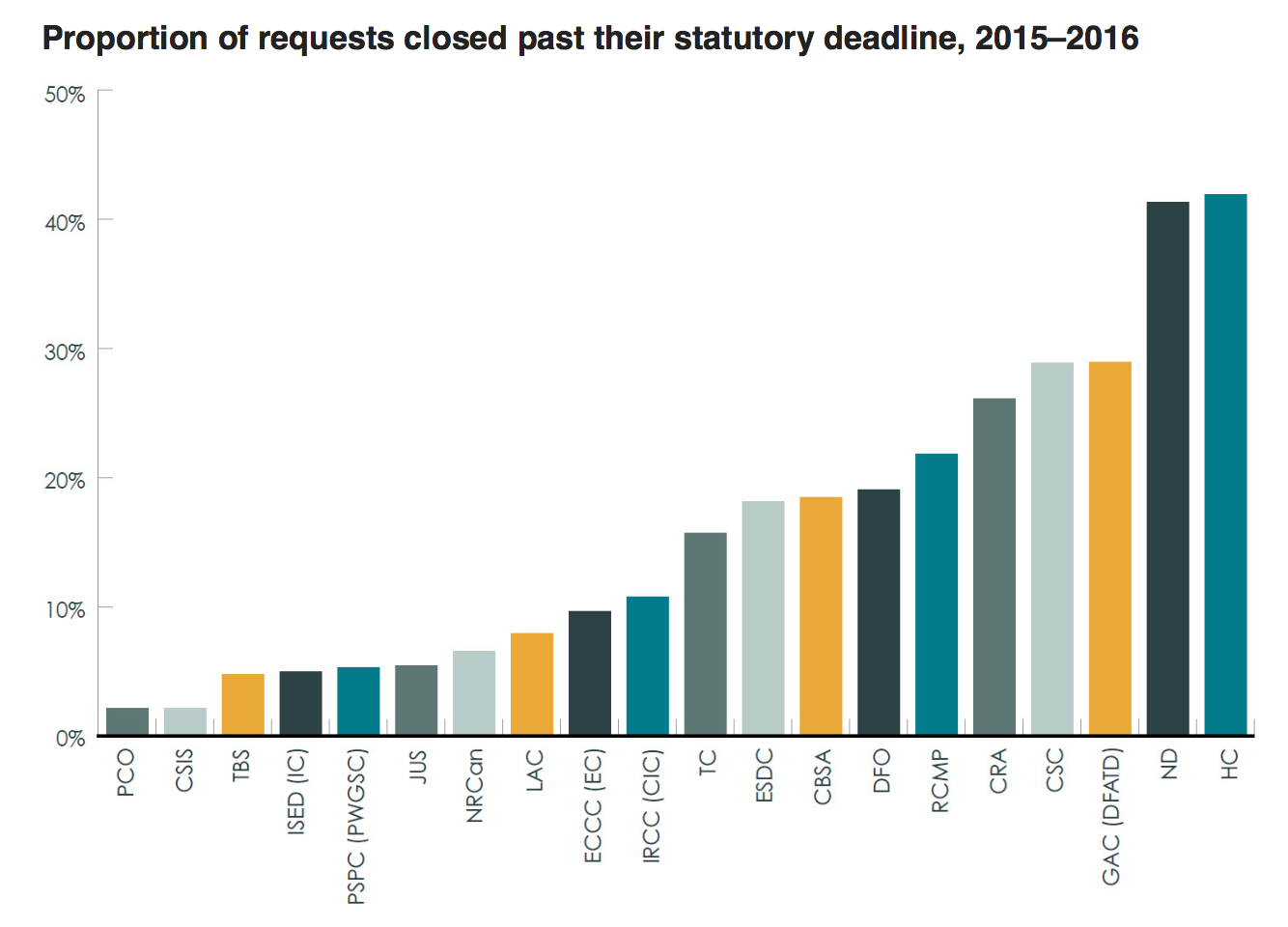
In terms of timeliness, the RCMP, the Canada Revenue Agency, the Correctional Service and Global Affairs received F grades, while National Defence and Health Canada were branded with the even more serious Red Alert status.

Legault’s report says she referred one case to the attorney general last month after uncovering apparent improper deletion of emails by an employee of Shared Services Canada.

Culture change needed on government openness1:21

The latest federal budget contained no funding for transparency measures and there has been no direction from the head of the public service on increasing transparency, Legault said.

Trudeau’s promises of making the government more open and accountable must be accompanied by action, she told a news conference. “I think he needs to do more. And I think he needs to make sure that the bureaucracy does more. It’s not enough to say it.”

The Liberal government recently acknowledged it is delaying planned reforms to the 34-year-old law due to the complexities of the task — changes Legault maintains are essential and long overdue.

The promised amendments include giving the information commissioner the power to order the release of government records and ensuring the access law applies to the offices of the prime minister, cabinet members and administrative institutions that support Parliament and the courts.

Action, not talk, needed

Treasury Board President Scott Brison said Thursday that reforms are coming, though he did not say exactly when. “We agree, actually, with the commissioner about the need to modernize the act.”

New Democrat MP Daniel Blaikie, who sat on a Commons committee that recommended a sweeping overhaul of the law, said Thursday it’s clear what needs to be done. “It’s just a real disappointment for people who took the government at its word in terms of openness and transparency and all the rest.”

Brison did take a first step last year, issuing a ministerial directive to enshrine the principle that federal agencies should be “open by default.”

Legault said the move, on its own, is not sufficient.

“If you want to truly change a whole culture in a very large bureaucracy, you’re going to have to make a concerted effort. There are going to have to be clear messages from the prime minister, the responsible ministers, the clerk of the Privy Council,” she said.

“Sadly, champions for transparency are absent.”

Source: Government uses Access to Information Act as ‘shield’ against openness: czar – Politics – CBC News

StatsCan’s website struggled with software issues for almost a month, emails show

More bad news about Shared Services Canada:

Statistics Canada’s busy website was partially disabled for much longer than previously reported, as technicians struggled for more than three weeks to bring all of its functions back.

The long, slow road to web restoration is documented in a series of emails obtained by CBC News under the Access to Information Act — emails that raise fresh questions about the performance of Shared Services Canada, the government’s controversial IT agency.

The Statistics Canada website was taken offline late on March 9, after the government was alerted the day before that a common web software tool, known as Apache Struts 2, was vulnerable to hackers.

The Canada Revenue Agency site was taken down for the same reason, just as tax-filing season began.

At a March 13 news conference, a government official said the problems had been resolved after three days.

“We are pleased to note that any affected websites have been patched and have been returned to normal operations,” said Jennifer Dawson, of the Treasury Board Secretariat. Officials said at least one hacker got into the Statistics Canada site, but did no damage, and confidential CRA data was never compromised.

The CRA website appeared to operate without further problems after the fix.

But the released emails show the Statistics Canada website remained dysfunctional for weeks as a series of new problems were revealed.

“We received the results this morning and there are still some vulnerabilities so the focus will be to fix them and re-scan them today,” says one March 27 update.

Shared Services Canada, the troubled IT agency now responsible for maintaining Statistics Canada’s website, confirmed to CBC News that there were “intermittent outages” until April 4 — or 26 days after the problems were first identified.

The emails also suggest Statistics Canada was sometimes not in the loop as Shared Services Canada worked to restore the public-facing website, which is virtually the only means for widely disseminating data to Canadians.

Morning after

The decision to take down the website was made by Shared Services Canada, rather than by chief statistician Anil Anora or other senior Statistics Canada officials.

Internal emails suggest that a problem with Statistics Canada’s website was not reported to the current chief statistician, Anil Anora, until the day after Shared Services Canada decided to take down the site.

Anora and the other officials only learned it had come down the morning after, shortly before the Labour Force Survey — a key monthly jobs report — was scheduled to be posted online, emails show.

Wayne Smith, the former chief statistician who resigned in protest last September citing Statistics Canada’s eroding independence, says the incident shows the agency is still beholden to an ineffective IT provider.

“This was the longest outage of Statistics Canada’s website since it began operation,” Smith said after reviewing the released emails. “There is a risk of this type of event becoming ever more frequent, resulting in a serious degradation of service.”

And despite the Liberal government’s efforts to fix Shared Services Canada, the IT agency remains a problem for other government departments as well, he said.

“Still the same crowd, steering the bureaucratic boat that brought us the failed email system, Phoenix, the outrageously expensive integrated government website, and projects spinning out of control that haven’t yet hit the headlines.”

The released emails have numerous redactions, most to protect security information, and Shared Services Canada declined to fill in the blanks.

‘Consulted’ with StatsCan

A spokesperson for Shared Services Canada, Andrée Gregoire, said the agency “consulted” with Statistics Canada before taking the web servers offline, though a released email uses the word “notified.”

Source: StatsCan’s website struggled with software issues for almost a month, emails show – Politics – CBC News