Why aren’t we looking into the Saudi role in San Bernardino attack?

Neil MacDonald, on Saudi Arabia and the uncomfortable parallel with ISIS:

Usually, executions — more than 150 so far this year — are performed with a “godly” sword. In public, of course, for the entertainment of a self-righteous crowd. But there are also crucifixions and mutilations.

SAUDI-ELECTION/

Saudi woman Fawzia al-Harbi, a candidate for local municipal council elections, sits next to one of her chaperones at a shopping mall in Riyadh last month. Saudi Arabian women are running for election and voting for the first time on Dec. 12, but their enfranchisement marks only a pigeon step towards democracy and gender equality in the Islamic kingdom. (Reuters)

Saudi women are treated better than immigrants, but are still severely oppressed, and treated like chattels of the male population.

If that all sounds like the modus operandi of ISIS, which the Saudis have been accused of having funded and armed before becoming a stout ally in the U.S. bombing campaign, well, the shoe does fit.

The Saudis have actually threatened to sue anyone who makes the ISIS comparison, but objectively, it’s not unreasonable.

The main difference is that the Saudis are extremists who managed to create a nation and have it recognized. And of course their king doesn’t claim to lead a new caliphate.

It’s almost a cliché to say this is all about oil, and the Saudi willingness to sell it, and sell it cheaply in unlimited quantities, to the West.

Because it is about oil. It’s also about the Saudis’ willingness to spend billions of that petro-revenue back in the West, signing contracts for military materiel that our governments are ecstatic to arrange.

If you’re inclined to think otherwise, try this mental exercise: imagine if Cuba, or Russia, or Venezuela (or even Canada) had produced 15 of the 19 9/11 hijackers, and had remained a consistent leader in exporting murderous ideology, and radicals like Tashfeen Malik.

Source: Why aren’t we looking into the Saudi role in San Bernardino attack? – World – CBC News

San Bernardino shooting highlights tensions within Islam

More on the Saudi influence on radicalization by Nadeem F. Paracha:

Faisal Shahzad, the American-Pakistani who tried to blow up New York’s Times Square in 2010, had also spent some time in Saudi Arabia. Like Tashfeen, he, too, belonged to a middle-class family.

The authorities in Pakistan still have no clue how to address the phenomenon of educated and relatively well-to-do young people becoming overtly radicalized to the point of committing grave violence.

The country’s military establishment, along with the government headed by the moderate center-right party, the PML-N, has unleashed a widespread operation against hardened and organized militants.

Part of the operation also includes an elaborate plan to neutralize the harder and more puritan stands of the faith that have seeped into various sections of Pakistani society ever since the 1980s.

This aspect of the operation has been tougher to implement because one major section of PMLN’s vote-bank in the Punjab is made up of men and women whose economic status has been enhanced by the money they made in the Gulf states.

But, again, till now, though such Pakistanis have often been known to denounce the faith followed by most of their compatriots and to fund a number of apolitical Islamic evangelical outfits that preach their kind of Islam, they are never expected to cross the line that separates them from militancy.

Ready-made narratives

However, as one Pakistani psychologist suggested two years ago at a seminar, young people in Pakistan with serious emotional problems and unresolved psychological issues are now being handed ready-made religious and political narratives by populist electronic and social media outlets. These narratives, he said, encourage them to give violent expression to their angst, confusion and failures while believing that they are doing so for a grander, more divine cause.

This seems to have been the case with Tashfeen. Hailing from a small town family steeped in indigenous forms of the faith; allegedly flown away to Saudi Arabia by a stubborn father who believed his country’s people were “flawed Muslims” and that “true Islam” was practiced only in Saudi Arabia; returning to Pakistan as a young woman and perhaps coming to the conclusion that her father was correct; linking up with an equally disgruntled soul from the US; marrying him; and then finally discovering her true calling: mass murder.

Hers was a psychotic break emerging from unresolved emotional issues, but combined with a warped politico-religious narrative that simply promised her a catharsis. But it was a catharsis that left 14 innocent people dead; a six-month-old child scarred for life; and a Muslim community in the US scratching their heads and wondering where they went wrong in simply trying to lead “pious lives.”

Source: San Bernardino shooting highlights tensions within Islam | World | DW.COM | 07.12.2015

Jim Maclean: In Ontario, a new race-based government | The Limits of Anecdote and Assertion

This commentary by Jim Maclean illustrates the risk of anecdote and assertion-based commentary Highlights of his piece:

Wynne told the Post that it’s time to use “the race lens” when formulating government policy, adding, “we need to start,” although she said she has yet to discuss the idea formally with cabinet. But if she is musing about it in public, you can bet a formal proposal is in the works.

To ensure the government’s “race lens” focuses properly, Wynne says a “structure” will need to be created “that is going to allow us to filter the policies we put in place, to create new policies to put protections in place.” How these race-based “protections” will differ from or supersede the broader (but apparently inadequate “human rights” protections that already exist in Canada’s Charter of Rights and Freedoms and many other pieces of provincial legislation is unclear. Also yet to be determined: the shape and size of the “structure” that Ontario will need to establish to filter government policies through Wynne’s “race lens.” Will it be akin to the bureaucracy that administers Quebec’s French language laws?

If anything, it will likely be bigger, because in order to ensure that Ontario’s current and future policies are properly “racially focused,” a large and racially-diverse number of civil servants will need to be hired so that the filtering is fully representative of all of the racial groups that make up Ontario’s diverse population. How else to ensure that the racial lens focuses correctly?

But let’s not stop with race. What of ethnicity? To be truly sensitive and inclusive, perhaps “ethnic” lenses may have to be used in addition to “racial” lenses, to focus more accurately, because, of course not all members of a particular race share the same views.

A little thinking is clearly a dangerous thing, and perhaps the Premier should do a lot more thinking about this initiative.

Once Ontario’s new Ministry of Racial Profiling has been set up, it will likely take years for all existing provincial government policies, and all future policies, to be correctly filtered. A tremendous, bureaucratic make-work project.

To be fair, each and every policy would have to be considered, would it not? And why stop with government policies? Why not have the Ministry examine all existing Ontario legislation? That would be the only fair and, um, consultative, thing to do.

….One can only hope that intelligent, thoughtful opponents to this ill-considered proposal will find their voices, and that they do so soon, before serious damage is done to the multi-racial and multicultural fabric of Ontario.

So, as hopefully an intelligent and thoughtful proponent of a diversity lens, let me note a few fallacies in his arguments:

  • Ontario is the second most diverse province, with 26 percent visible minorities, and with greater diversity within visible minorities than British Columbia;
  • When devising policies and programs, it is important to understand the needs of the population served. In Canada’s four largest provinces, that means understanding the range of groups being served;
  • Government has long-applied a gender lens to various policies and the federal government did apply a rural lens at one time;
  • This is no different from the private sector, where sectors as diverse as banks, grocery chains, fast food outlets and telecoms all conduct such research to better understand, and respond to, client needs;
  • Understanding citizen needs does not automatically mean a targeted policy or program response but it ensures policy makers have the necessary information to make recommendations; and,
  • any response can range from substantive policy or program adjustments to improve outcomes, or improved ways to let citizens know about government programs that may be relevant to them.

From the theoretical to some practical examples:

  • Would police-carding practices not have been questioned if a race-lens highlighted the disproportionate carding of Blacks?
  • Would the Toronto District School Board have been able to develop programming to improve high school graduation rates among Somali-Canadian youth without a diversity lens?
  • Would the roll-out of Ontario’s new sex education program not have been smoother had resistance from some segments of some communities been identified earlier through such a lens.

Lastly, to Maclean’s fear that the Ontario government will have to hire a “large and racially-diverse number of civil servants,” he can rest easy: 20.4 percent of Ontario’s public service are already visible minority.

In any case, the purpose of a “lens” is for all public servants, whatever their origin, to become more attuned to the population they serve.

Source: Jim Maclean: In Ontario, a new race-based government | National Post

Income and mobility of immigrants, 2013

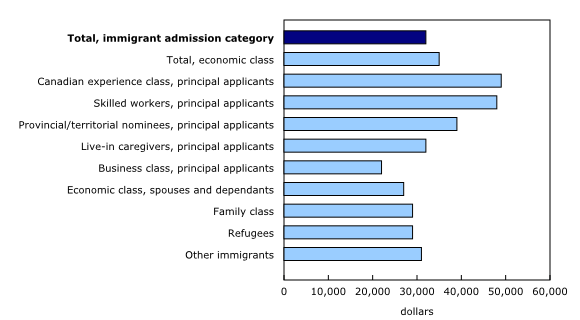
Latest from Statistics Canada. Striking that median income differences are relatively small, save for Canadian Experience Class, Skilled Workers and Provincial Nominees (above the median), Business Class below the median and below Refugees):

Employment income of immigrant taxfilers varies by the category under which they were admitted

The immigrant taxfilers who landed in Canada since 1980 as principal applicants under the Canadian experience class and skilled workers categories earned more in 2013 than other immigrants. Their median employment income was estimated at $49,000 and $48,000 respectively, while it was $29,000 for those admitted under the family and refugee classes.

Chart 1  Chart 1: Median employment income of immigrant taxfilers by immigrant admission category, 2013
Median employment income of immigrant taxfilers by immigrant admission category, 2013

Chart 1: Median employment income of immigrant taxfilers by immigrant admission category, 2013

Employment income of immigrant taxfilers increases over time since landing in Canada

The median employment income of immigrant taxfilers who landed in 2003 was estimated at $15,800 in 2004 (one year after landing). For the same cohort, it increased to $26,000 in 2008 and rose to $32,000 in 2013.

The median employment income of refugees who landed in 2003 also increased over the same period. While it was $13,800 in 2004, it increased to $18,600 in 2008 and rose to $23,000 in 2013.

The retention of immigrant taxfilers is lower in the Atlantic provinces than in other provinces

In 2013, 91% of immigrant taxfilers who had landed one year earlier filed taxes in their province of landing. The proportions were the highest in Alberta (96%) and Ontario (94%). The Atlantic provinces had lower retention: 79% in Nova Scotia, 70% in New Brunswick, 68% in Newfoundland and Labrador and 43% in Prince Edward Island.

Source: The Daily — Income and mobility of immigrants, 2013

How fear became the politician’s weapon of choice

Ian Buruma on the politics of fear:

As long as France’s state of emergency lasts, police may arrest people without warrants, break down the doors of private residences in the middle of the night, take over restaurants and other public places with armed force, and generally behave like agents in a police state. Most French citizens are now so frightened of Islamist attacks that such measures are widely supported. But they are almost certainly counterproductive.

A national leader can declare war on a state, not on a network of revolutionaries. Islamic State, despite its claims, is not a state, and Mr. Hollande should not treat it as one. Besides, even if bombing IS strongholds in Iraq or Syria makes military sense, it won’t break the spell of Islamist revolution for frustrated, bored and marginalized young people in French slums.

On the contrary: The canny leaders of IS also rely on an apocalyptic “us or them” view of the world. Most Muslims are not violent revolutionaries who condone, let alone admire, mass violence. IS seeks to broaden its support, especially among young Muslims, by convincing them that true Muslims are in an existential war with the West – that the infidels are their mortal enemies. For them no less than for Mr. Trump, fear is the most powerful weapon.

So the more a Western government allows its policemen to humiliate and bully Muslims in the name of security, the more IS is likely to win European recruits. The only way to combat revolutionary Islamist violence is to gain the trust of law-abiding Muslims in the West. This will not be easy, but arbitrary arrests are surely the wrong way to go about it.

Likewise, when it comes to civil wars in the Middle East, Western restraint is usually a better strategy than hasty military intervention driven by domestic fear. Republican candidates in the United States are already using the recent murder spree in Paris to blame President Barack Obama, and by extension any future Democratic candidate, for being weak. Mr. Trump has promised to “bomb the shit out of ISIS.”

This bellicosity has had the effect of pushing Hillary Clinton, the front-runner for the Democratic presidential nomination, into distancing herself from Mr. Obama. As with Mr. Hollande, she has to assuage public fear by talking tough and promising more military action.

Mr. Obama has consistently resisted the temptation to unleash more wars. His policies have sometimes been inconsistent and irresolute. But in his refusal to give in to panic and act rashly, he has been far braver than all the big talkers who accuse him of being a wimp.

Source: How fear became the politician’s weapon of choice – The Globe and Mail

Trudeau Cabinet takes diversity, inclusiveness to an unparalleled extent | hilltimes.com

My piece in The Hill Times:

The Liberal government has emphasized its diversity and inclusive language in speeches, in Cabinet, in Cabinet committees, and in Cabinet ministers’ mandate letters. This emphasis has been reinforced by the return of the multiculturalism program to Canadian Heritage. All together, these initiatives represent the mainstreaming of diversity, inclusiveness and multiculturalism to an unparalleled extent.

It starts with the language of Prime Minister Justin Trudeau who regularly emphasizes that: “Canadians understand that diversity is our strength. We know that Canada has succeeded—culturally, politically, economically—because of our diversity, not in spite of it.”

It continues with the creation of the Cabinet Committee on Diversity and Inclusion, with a strong inclusion mandate for indigenous and new Canadians: “Considers issues concerning the social fabric of Canada and the promotion of Canadian pluralism. Examines initiatives designed to strengthen the relationship with indigenous Canadians, improve the economic performance of immigrants, and promote Canadian diversity, multiculturalism, and linguistic duality.”

It is reflected in his choice of ministers: 50 per cent women, 17 per cent visible minority. And is further reinforced in the shared mandate letter commitments for all ministers with two strong multiculturalism-related commitments: “Canadians expect us, in our work, to reflect the values we all embrace: inclusion, honesty, hard work, fiscal prudence, and generosity of spirit. We will be a government that governs for all Canadians, and I expect you, in your work, to bring Canadians together.

“You are expected to do your part to fulfill our government’s commitment to transparent, merit-based appointments, to help ensure gender parity and that indigenous Canadians and minority groups are better reflected in positions of leadership.”

Holding all ministers to account, with PMO tracking of these and other shared commitments (in addition to minister-specific commitments), should ensure greater progress on the two objectives of multiculturalism:  recognition and equality.

It will take some time to see how well these commitments are implemented.

Equally important, the previous government’s weak record on the diversity of judicial appointments (less than two per cent visible minority) will start to be addressed.

Overall, the new government made few changes to how government is formally organized (machinery changes). This was wise given the disruption and turmoil that such changes can entail (e.g., the Martin government’s splitting apart Human Resources and Skills Development and the Department of Foreign Affairs and International Trade in 2004, reversed by the Harper government in 2006).

This makes the return of the multiculturalism program to Canadian Heritage all the more striking, after some eight years at Citizenship and Immigration (now Immigration, Refugees and Citizenship or IRCC).

The original transfer to CIC was largely driven by political reasons given then Immigration minister Jason Kenney’s political outreach role with ethnic groups. However, there was also a policy rationale. Multiculturalism deals with longer-term multi-generational issues (along with ‘mainstream’ visible minority relations) in contrast to the newcomer focus of the immigration, integration and citizenship programs, and multiculturalism could be seen as a logical extension of CIC’s mandate, and was portrayed as such in one of CIC’s strategic objectives, ‘building an integrated society.’

In practice, however, the multiculturalism program withered away at CIC.

When the program moved to CIC in 2008, it had a $13-million budget: $12-million for grants and contributions and 73 full-time positions. The last departmental performance report (2013-14) showed 29 full-time positions (a decline of 60 per cent) with a $9.8-million budget. Money for grants and contributions fell to $7.9-million.

Negotiations over the resources to be returned to Canadian Heritage will be challenging, given the impact may be felt in other program areas in IRCC that benefited from the redistribution of Multiculturalism funds. Moreover, the weakened capacity will require a major rebuilding and restaffing effort.

From a policy perspective, the return of multiculturalism to Canadian Heritage reinforces the overall government diversity and inclusion agenda, as well as the Canadian identity agenda, which fits nicely with Canadian Heritage’s overall mandate.

However, Canadian Heritage Minister Mélanie Joly’s specific mandate letter commitments make no mention of multiculturalism. This apparent oversight may just be to provide the public service time to manage the return of multiculturalism and reintegrate within Canadian Heritage. Furthermore, the lack of a junior minister may make it harder for the multiculturalism program to define its new role within Canadian Heritage and, more broadly, across government.

Joly’s public statements to date have not included any significant references to multiculturalism. Her general orientation, however, has been clear: to promote the “symbols of progressiveness. That was (sic) the soul of our platform.”

Overall, the commitment to a diversity and inclusion agenda, supported by a Cabinet committee and shared ministerial mandate letter commitments, and the rebuilding of multiculturalism back at Canadian Heritage bode well for a more effective inclusion, diversity, and multiculturalism strategy across government.

Source: Trudeau Cabinet takes diversity, inclusiveness to an unparalleled extent | hilltimes.com
There will be some hard things said: Muslim group hears about Truth and Reconciliation

Another good initiative in building bridges and understanding by the Canadian Council for Muslim Women:

It’s a been a time of soul-searching for Muslims trying to find their place in Canada. That’s why it’s the right time to hear about Truth and Reconciliation right from the source, says the organizer of a panel that brought Muslim and Aboriginal people together.

“I thought we should take a step back and put our own problems into perspective,” said Ferrukh Faruqui, who moderated the event on Saturday.

Faruqui grew up in Winnipeg and went to medical school there, but admits she knew little of the historic struggles of Canada’s First Nations. “We want to listen to truths long buried and offer our support.”

The panel organized by the Ottawa chapter of the Canadian Council for Muslim Women consisted of Faruqui as moderator and three guests: Minwaashin Lodge co-founder Irene Compton;  Victoria Tenasco-Commanda, the culture co-ordinator at the Wabano Centre for Aboriginal Health, and Shady Hafez, a Carleton University student whose mother is Algonquin and father is Syrian.

The panel spent much of its time talking about echoes of the residential school system, which operated for more than 150 years. Some 150,000 aboriginal children went through the system, and thousands never returned home. The last school closed only about 20 years ago. The Truth and Reconciliation Commission, which probed the history of that school system and its lasting repercussions were released last June in a summary report. A final report is to be released Dec. 15.

“I am going to warn you that there will be some hard things said,” warned Compton before she started to speak.

Source: There will be some hard things said: Muslim group hears about Truth and Reconciliation | Ottawa Citizen

No surprise here: Canada a turnoff for some refugees – Saunders

Doug Saunders on Canadian smugness:

It was only in the early 20th century, under Wilfrid Laurier’s leadership, that Canada learned to attract and keep people – by spending serious money on agencies and campaigns abroad, and giving people land and cash to come. No period has come close to the Laurier decade for keeping immigrants.

We soon fell back to our exclusionary patterns. With the exception of the 1910s and the 1950s, immigration in the 20th century contributed little to Canada’s population growth: In many decades people didn’t want to come; in others, people arriving barely outnumbered those departing. We spent much of that century turning away refugees and warning each other about the civilizational threats posed by southern and eastern Europeans and Asians. Only after 1999 did immigration, for the first time, overtake childbirth as the main source of population growth.

Still, we spend more money keeping newcomers out, and throwing obstacles in the way of their settlement and citizenship, than we do welcoming them. The mean-spirited politics of the past decade, the policies denying health care to asylum seekers and the cruel temporary-worker rules and family-reunification restrictions are well known overseas, and the best-qualified people would rather go elsewhere. We think we’re a hot date, but we really need to upgrade our Tinder profile.

Even in Britain, Canada has become a turnoff: We are currently the fourth-most-popular country for British emigration, far behind Australia (which receives twice as many people), the United States and Spain. In fact, it’s a net loss: During the past decade, an average of 5,200 British emigrants came here each year, while 8,500 moved the other way. Worse, the British Post Office surveyed British emigrants, and the happiest were those in France, Spain, the United States, Australia and Thailand – Canada didn’t make the list.

We should heed the lesson we learned a few years ago in Ireland: After the country’s economy collapsed in 2008, Ottawa hoped for a migration boom of skilled workers. But only about 1,000 a year came, and they complainedabout unfriendly conditions and unaffordable cities. Only after paying for a big advertising and outreach campaign did that rise to 5,000 – for a year, until things got better in Ireland.

Next time we have a months-long national debate about migrants, maybe it shouldn’t be about them, but about us – why we still seem so cold and unwelcoming, even to those we want.

Source: No surprise here: Canada a turnoff for some refugees – The Globe and Mail

A modern public service has great expectations to meet: Lynch

Kevin Lynch’s (former PCO Clerk) prescriptions for rebuilding the public service:

First, a strong analytic policy capacity that is both broad and deep is a basic necessity of effective governing in an increasingly interconnected, complex and uncertain world….

Second, a risk-management orientation. In a world experiencing a sharp spike in risk and volatility, the smart response by government is proactive  not reactive – risk management….

Third, an innovation focus. In a world where technological innovation is at an inflexion point, disrupting how business is done in sector after sector, government should be at the leading edge of innovation adaptation. It is not.  …

A re-empowered public service can be a magnet for talent and contribute significantly to Canada’s long-term success as a strong economy and vibrant society. It now has great expectations to meet.

Source: A modern public service has great expectations to meet – The Globe and Mail

How Young Brains Get Radicalized – The Daily Beast

Not surprising, the same neuroscience that helps explain greater willingness to take risks (e.g., drunk driving, extreme sports etc) also plays a role in understanding susceptibility to radicalization:

Fortunately, findings from neuroscience may help us to understand where these vulnerabilities exist, and why some brains—particularly adolescent brains—are more susceptible to believing whatever they are fed. Such neural insights are important because they contribute to a better understanding of how to combat radicalization here at home.

According to peer-reviewed research, radicalization is made easier in brains that have impaired functioning in one of the main regions responsible for generating the ability to doubt. Specifically, scientists have found that damage to the brain area known as the ventromedial prefrontal cortex (vmPFC) may cause individuals to have a “doubt deficit”—a hindered ability to question, scrutinize, or be skeptical of new information.

In a 2012 study published in the journal Neuropsychology, researchers found that patients with damage to the vmPFC scored higher on measures of religious fundamentalism and authoritarianism compared to others.

Such qualities would make people with similar impairments, such as those with decreased or disrupted brain activation in the vmPFC, the perfect prey for ISIS recruiters. According to the authors of the study, “Individuals high in authoritarianism tend to easily submit to authority, are often aggressive in the name of authority, and tend to hold dogmatic beliefs without a reflexive critique.”

So the question is, who possesses poor brain circuitry in the prefrontal cortex that could produce doubt deficits? The unsettling answer: young people.

There is overwhelming evidence that teenagers and those in their early 20s have brain circuits in the prefrontal cortex that are still developing. It may come as no surprise that this brain region is also involved in controlling impulses, regulating our emotions, and making sound decisions. The brain’s wiring simply hasn’t had a chance to make all the proper connections to support such behavior.

This falls in line with what is actually being observed in the real world. Teenagers are commonly targeted through the Internet by ISIS recruiters, like 19-year-old Asher Abid Khan from Texas, who was drawn to the group after watching propaganda videos put up by ISIS online.

In another case, ISIS members spent months carefully grooming a 23-year-old female named Alex, who was a devout Christian and Sunday school teacher. A recruiter known to her only as “Faisal” provided the lonely girl with constant companionship by spending hours communicating with her through Skype, Twitter, and email, teaching her the fundamentals and rituals of Islam as a first step.

By being so persistent, ISIS recruiters are also exploiting the brain’s natural tendency to accept beliefs rather than reject them. Since the latter requires an additional evaluation phase, which means more work for the brain, its default state is to believe.

These accounts clearly show that ISIS recruiters recognize the young brain’s vulnerabilities—and how to take advantage of them. If we want to protect against their techniques, we have to understand these vulnerabilities as well.

Source: How Young Brains Get Radicalized – The Daily Beast