Quebec needs to confront its Islamophobia problem
2015/12/15 Leave a comment
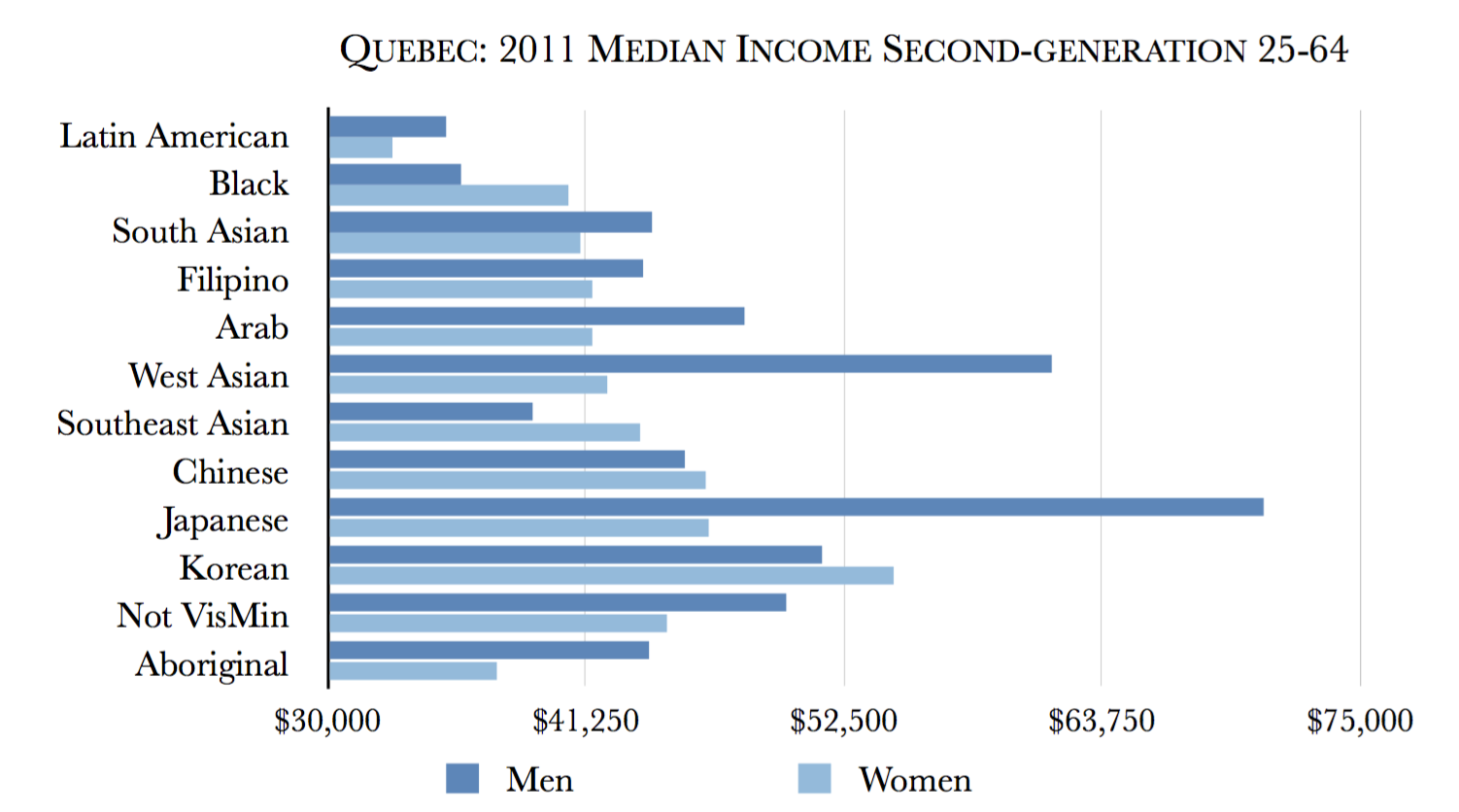
More on the challenges faced by Muslims in Quebec by Amarnath Amarasingam and Higham Tiflati. Overall, economic outcomes for immigrants and their children are lower than elsewhere in Canada:
While Islamophobia and anti-Muslim animus exists throughout Canada, the nature of it in Quebec seems to be unique, and quite worrisome. Law-enforcement officials and social workers receive calls from concerned citizens wanting to report “suspicious persons” like a man with a long beard in their neighbourhood, and calls from concerned families asking whether their relative, a new convert to Islam, could become a terrorist.
Muslim students also report that Francophone CEGEPs do not allow their students to create Muslim Students’ Associations (MSAs), a policy not even practiced by Anglophone CEGEPs in Quebec.
Polling data backs up much of what these young people are expressing. A 2015 Quebec Human Rights Commission survey found that 43 per cent of Quebecers believe we should be suspicious of anyone who openly expresses their religion, with 49 per cent expressing some uneasiness around the sight of Muslim veils.
For many Muslim youth, this kind of public scrutiny is deeply alienating. Young Canadians from other ethnic and religious backgrounds have the privilege and the freedom to wrestle with adolescent identity issues in private. These struggles, ones we have all experienced, play out quite differently for Muslim youth.
Aspects of Muslim youth identity, such as whether to wear the hijab, are quite often national debates, discussed on the nightly news, and even find their way into speeches given by the prime minister. The young girl wearing a hijab is not someone who has made a fairly harmless and rudimentary religious choice, but is seen as someone making a political statement about Western values or ways of life.
It is no surprise then that these youth express an emotional exhaustion arising from being constantly watched, scrutinized, and pitied. Fairly mundane activities such as walking down the street or riding the bus become “events,” requiring mental and psychological fortitude. It takes a deep toll on their confidence, self-esteem and sense of inclusion. As Safiya remarked, “Shayma didn’t want to feel like a stranger here any more.”
Safiya, though, is committed to changing her life in Quebec, and changing the way Quebecers see her and her community. She has dreams and goals. “My parents brought me here for a reason,” she says. “Sure, things are not perfect, but I see potential in our Muslim community here in Quebec and if everyone just left it won’t help.”
Source: Quebec needs to confront its Islamophobia problem | Toronto Star
 About Andrew
 Multicultural Meanderings