Canadians adopting from Muslim countries caught in legal limbo

Seems a bit odd given that the US and UK permit adoptions from Muslim countries, and CIC’s rationale is not articulated beyond the usual process reasons:

Canada maintains that kafala does not qualify as adoption, arguing that the arrangement does not sever legal ties with a child’s biological parents.

Other Western countries, including the United States and United Kingdom, have policies allowing kafala arrangements to be legally recognized there.

Canada’s position on kafala can leave families who have received guardianship in Muslim countries caught in a bureaucratic web that appears to be unique to Canada, and unable to bring their children home.

Nusrat Munshi obtained legal guardianship of Aleeza just two months after the little girl was abandoned at a Karachi orphanage. (Submitted by Nusrat Munshi)

Citizenship and Immigration Canada spokeswoman Nancy Caron says it is not Canada’s policy to discriminate against any country when it comes to adoption.

“Eligibility of individual countries for inter-country adoption is determined on a case-by-case basis by the provinces and territories based on Canadian laws, and with respect for international laws as well as the statutes and wishes of the originating country.”

However, Amirzadeh says whether it’s an official government policy or not, the red tape effectively discriminates against Muslim families. “It’s like saying, ‘You’re born there, so you’re doomed.'”

And while a formal ban on adoptions from Muslim countries isn’t currently official policy, Canada hasn’t entirely ruled one out.

Documents obtained through access to information show that in 2013, the provinces and territories debated a ban on adoptions not only from Pakistan, but other Muslim countries, too.

At least two provinces, British Columbia and Ontario, refused the proposal, according to the documents.

“At this time, there is no intention of extending this closure to inter-country adoptions from other countries, although this does not limit such actions being taken in the future if determined to be warranted,” Citizenship and Immigration Canada wrote then.

Michael Blugerman, a Toronto-based adoption agent who was licensed to process adoptions from Pakistan for years until the 2013 ban, says while the government needs to make sure adoptions are legitimate, lumping cases from Muslim countries together isn’t the answer.

“It’s what I’d call a cultural-religious-profiling problem,” he says.

Meanwhile, Canada and Pakistan differ over the reasons for the adoption ban.

Citizenship and Immigration spokesperson Remi Lariviere says that adoptions from Pakistan were suspended through “ongoing procedural evaluations by the Government of Canada with input from the Government of Pakistan.”

But it seems Pakistan is not objecting to adoptions.

“It was a decision of the Government of Canada,” says spokesperson Nazia Khalid of Pakistan’s High Commission in Ottawa. “If they decide not to allow adoption, what can the Pakistani government say about it?”

Canadians adopting from Muslim countries caught in legal limbo – Canada – CBC News.
Conservative judges, bureaucracy, Senate a likely constraint on future government: Atkin

David Akin on the possible constraints facing an incoming new non-Conservative government, using PM Harper’s 2006 language regarding Liberal constraints on an incoming Conservative government:

“The reality is that we will have, for some time to come, a Liberal Senate, a Liberal civil service, at least at the senior levels where they’ve been appointed by the Liberals, and courts that have been appointed by the Liberals,” Harper said. ”These are obviously checks on the power of a Conservative government. That’s why I say … there is certainly no absolute power for a Conservative government and no real, true majority.”

Though all those checks and balances might seem obvious, the Martin Liberals used this comment by Harper as an attack point, to suggest that, absent all those Liberal judges and bureaucrats, Harper would impose a Conservative revolution on the otherwise peaceable kingdom that was Canada in 2006.

The Liberal attacks were successful to a point: They helped keep Harper’s win to a minority.

But now, more than eight years later, as we look at the polls and consider the possibility of another ideologically driven party, the New Democrats, potentially forming government, it’s useful to consider the wisdom of what Harper said at the end of that 2006 campaign.

Right now, we have a Conservative Senate. There is not a single New Democrat senator. That’s a virtue now for NDP Leader Thomas Mulcair, but it could be a liability if he becomes prime minister and needs a Senate full of Conservatives and Liberals to pass his government’s legislation.

If course, the NDP has vowed to get rid of the Senate altogether. Good luck doing that without your own senators, New Democrats!

What about the civil service? Public sector union bosses might prefer a New Democrat government but an entire generation of leaders and managers in the civil service is now in place that were hand-picked by the Harper Conservatives. The Clerk of the Privy Council — the top bureaucrat among the 257,000 federal bureaucrats — is Janice Charette. She cut her political teeth as a former chief of staff to former Progressive Conservative leader Jean Charest and other PC ministers before going into the ‘non-partisan’ public service.

And then there are those judges. When Harper looked at the Supreme Court in 2006, all he saw was Liberals. But now, if Thomas Mulcair becomes PM and looks at the court, he will see 7 of 9 justices appointed by Harper, one — the Chief Justice Beverley McLachlin — appointed by Brian Mulroney and just one appointed by a Liberal PM.

By Harper’s own logic of 2006, between the Senate, the bureaucracy and the judiciary, there would be much to constrain an NDP government should that happen this fall.

Harper made that point in 2006, was attacked for making it, and won a minority government. Will Mulcair make the same point in this election season with the same effect?

Comments on senior officials is of interest. Suspect some may be vulnerable that have appeared to stray the line (but doubt that Charette would be considered among them).

And of course, as others have argued (and I in my book, Policy Arrogance or Innocent Bias: Resetting Citizenship and Multiculturalism), the Harper government distrust of the public service never was fully overcome.

Conservative judges, bureaucracy, Senate a likely constraint on future governmen.

Has Canada’s immigration system lost its heart?

Some good overall statistics on wait times, and a rather amusing comment from the CIC Minister’s spokesperson about anecdotes, given the reliance the government often places on anecdotes in formulating and communicating policy:

While the Conservative government has invested resources in expediting the processing of skilled immigrants, investors, refugees and people slated for deportation, wait times keep growing for family reunification programs.

Currently, it takes nearly four years (47 months) simply to assess a sponsor’s eligibility to bring in parents and grandparents. The aging would-be immigrants then have to wait years for their own assessment at visa posts abroad.

To sponsor a husband or wife already living in Canada takes 27 months. To renew a permanent resident card, it’s a minimum of 67 days; for citizenship, at least two and up to three years; and for eligible live-in caregivers to receive permanent status (so their spouses and kids can finally join them here), 44 months.

“I’m a proud Canadian and grateful for the opportunities this country has given me,” said Djordje Momcilovic, 48, an occupational health and safety consultant. “But I’m not proud that the Canadian government is promoting family values and reunion but in fact it is keeping and tearing families apart.” Momcilovic sought help from his local MP to temporarily delay his mother’s removal.

Immigration Minister Chris Alexander’s office said Canada will admit about 70,000 people as permanent residents under the family class in 2015.

“Anecdotal accounts are not necessarily more broadly representative or, unfortunately, even factual in some cases,” said Alexander’s spokesperson, Kevin Menard. “Certainly, each case is unique, and each is assessed on its merits based on the information applicants provide to officials.

“We are working to eliminate backlogs and reduce processing times of all kinds … Our government is committed to reuniting as many spouses and partners as possible, as quickly as possible, while ensuring permanent resident targets are met for all immigration streams.”

Has Canada’s immigration system lost its heart?

Canadian Race Relations Foundation: Directions Journal Call for Submissions

A reminder and should be an interesting edition, given the focus on words and lexicons:

Is our lexicon a positive force or part of the problem?

The Call for Papers for the Winter 2015 Issue is now open.

Published in print and online December 2015, The Power of Words speaks to the importance of reviewing and evolving social science terminology in response to changing demographics and settlement trends. The concept of hyphenated Canadians, terms such as ‘visible minorities’ and ‘newcomers,’ and even the idea of ‘race relations’ require ongoing reassessment, and are being challenged and re-examined in the context of our changing society.

Directions provides a space for established and emerging scholars, community organizations and race relations practitioners to publish their research. It also offers a forum for important dialogue and debate on race-related issues and best practices, and practical recommendations for policy development and change. Directions is curated to promote social cohesion amongst all individuals and groups living in a harmonious Canada.

Research Questions

How do language and lexicon in policy, in the media, and in daily interactions influence our experiences, identities, attitudes, and relationships? How can discourse create and perpetuate unbalanced power relations, marginalizing certain groups and individuals? How can we use language to promote positive race relations in a harmonious Canada?

These dynamic questions represent the types of issues that CRRF intends to explore in the upcoming issue of Directions in Winter 2015.

Call for Papers

Submit your research, editorial, abstract, or book review for the Winter 2015 Issue of Directions.

Submit a letter of inquiry or abstract by June 30, 2015 Submit online >


Ukraine Tears Down Soviet Symbols, Winks At Nazi Ones

Selective approach to history, destroying some monuments and keeping some others:

Both Soviet and Nazi symbols are now forbidden in Ukraine by law. But it’s the Soviet icons, once dumped on the country in industrial quantities, which now are disappearing in record numbers.

Since December 2013, Ukrainians knocked down 500 out of over 1,200 Lenin statues, a trend known as “Lenin-fall,” which in Ukrainian sounds like snowfall. Recently, Ukrainian President Petro Poroshenko signed a law that formally charged the state with removing Soviet-era monuments, so now Kiev’s municipal services are responsible for destroying statues.

…In April, 40 historians asked President Poroshenko not to sign the law recognizing a number of World War II nationalist organizations, including the Ukrainian Insurgent Army (UPA), as mere independence fighters. In a letter addressed to Ukrainian authorities the critics questioned the legitimacy of an organization “that slaughtered tens of thousands of Poles in one of the most heinous acts of ethnic cleansing in the history of Ukraine.”

Western historians pointed out that Ukraine should not be praising as heroes organizations that collaborated with Nazi Germany. The UPA “also took part in anti-Jewish pogroms in Ukraine and, in the case of the Melnyk faction, remained allied with the [Nazi] occupation regime throughout the war,” their letter said.

The U.S. Holocaust Memorial Museum has expressed concerns about Ukraine’s radical treatment of its history: “As Ukraine advances on the difficult road to full democracy, we strongly urge the nation’s government to refrain from any measure that preempts or censors discussion or politicizes the study of history.”

George Orwell put the fundamental problem rather more elegantly in an essay he wrote toward the end of World War II, when he argued that history is written by the winners. “The really frightening thing about totalitarianism is not that it commits ‘atrocities’ but that it attacks the concept of objective truth; it claims to control the past as well as the future.” And that tradition is one Ukraine is still trying to shake off.

Vyatrovych conceded, for instance, that some UPA activists were involved in Jewish pogroms, “since Jews were blamed for helping Bolsheviks,” but he rejected the idea that the whole of the UPA was at fault. “There were many Ukrainian nationalists who saved Jews, too, during the war,” he told The Daily Beast. “Besides, who could not be blamed for atrocities during that war? Americans bombed Dresden,” said Vyatrovych, whose title is director of the Ukrainian Institute of National Memory.

Ukraine Tears Down Soviet Symbols, Winks At Nazi Ones – The Daily Beast.

Girl players leave high school soccer game after complaints from Muslim boys’ team

Bad call but good corrective action:

The senior boys’ soccer team from Robert F. Hall Catholic Secondary School in Caledon, Ont., was up 3-1 at the half on Tuesday when the coach pulled aside Carla Briscoe, one of two girls on the team.

Briscoe, who was in the starting lineup, wondered if she was being called out for playing too rough, but it turned out the coach from the opposing school, ISNA High, an independent Islamic school in Mississauga, Ont., had told the referee his team could not continue playing because of the presence of girls on the field.

As much as the competitive 18-year-old senior wanted to continue playing, she agreed to sit out the rest of the game. The team needed the extra points and it would be unfair to stop the game when some of her teammates hadn’t taken to the field.

“I said to my coach, ‘I’d rather see everybody play. I don’t want to ruin this for the rest of the team. Me and the other girl will sit out.’ ”

Their team went on to win 6-1. But win or lose, the girls should never have been put in that situation, Paul Freier, chairman of the Region of Peel Secondary School Athletic Association (ROPSSAA), said Friday.

‘Our position on this is these are the rules of engagement. … Going forward, it’s our hope all teams will have an understanding’

The rules governing sports in the region mirror those set by the Ontario Federation of School Athletic Associations, which states if a sport is not available to girls at a school, they can join the boys’ team after a successful tryout.

Freier sent an email Friday to the ISNA coach making it clear schools must abide by those rules. If they don’t like them, they are free to leave the athletic association.

“Every school that joins ROPSSAA, it’s a voluntary membership,” Freier said. “We will continue to adhere strictly to those constitutions and bylaws.”

A statement issued by the school Friday said it regretted the female players felt they could not participate.

“It was never the team’s intention to exclude female participation, which was reflected in the offer to forfeit. The team sincerely regrets if any team members or participants were hurt or felt discriminated based on their gender.”

Earlier, Essa Abdool-Karim, the ISNA coach, told CityNews the team was “caught off-guard” by the presence of girls on the team.

Girl players leave high school soccer game after complaints from Muslim boys’ team

Chris Selley’s commentary:

Sometimes, religious accommodation is hard. Reasonable people will disagree. Is it an affront to secular society to allow a Muslim congregation to organize Friday prayers in a public school cafeteria? Or is it simply a practical way of minimizing disruption to the school day? Kirpans in schools? Public servants in niqabs? The Lord’s Prayer at city council? Hmm, well on the one hand, but on the other hand …

Sometimes, though, religious accommodation is not complicated. Sometimes you don’t even need those two words. Sometimes it’s just a soccer team refusing to play another soccer team. That’s what CityNews reports occurred this week on a Brampton, Ont., pitch: a team from ISNA Private Islamic High School objected to their opponents, Robert F. Hall Catholic School, fielding two girls. Losing 3-1 at halftime, the INSA team declined to finish the match unless the ladies left the pitch.

And you’ll never believe what happened next: “The girls on [the Catholic] team told CityNews they insisted on sitting out for the second half to allow the game to continue.”

Now, I choose to believe they did that so the thumping they were delivering could continue, perhaps redoubled in response to the No Gurlz complaint: Robert F. Hall added three more goals in the second half to win 6-1.

But they shouldn’t have been allowed to sit out. Period. Not by their coaches, and not by the referee. There is no need to parse the INSA coach’s attempts to foster what CityNews describes as an “an open dialogue.” There is no need to put ourselves in the INSA players’ shoes and walk a mile. “We want them to understand this balance between religion and having to sacrifice the sport you love is a difficult situation,” says the coach. “We want inclusion for all.”

This is dead simple: We have a perfectly good soccer team refusing to take to a perfectly good pitch to face another perfectly good team. Thus, they forfeit the game. Both teams advanced in the tournament. They might face each other again. The INSA coach told CityNews he doubted his team would agree to play. At last report the Region of Peel Secondary School Athletic Association was for some reason “gathering their facts” in order to determine “how to proceed” in this “uncharted territory.”

The facts: Perfectly good Team A refuses to play perfectly good Team B for no good reason. How to proceed: Team A forfeits. See how easy this is?

Don’t want to play soccer against girls? You lose

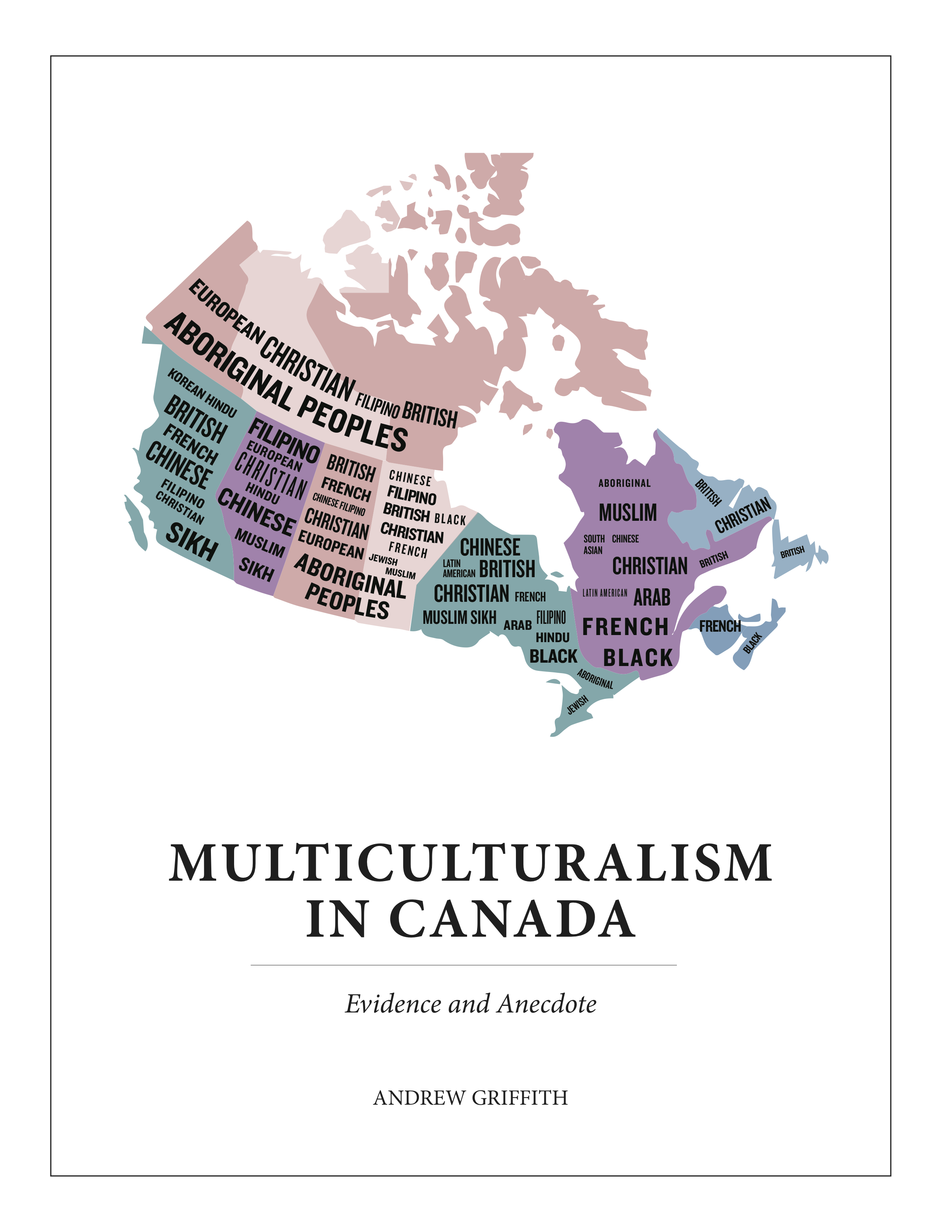
Multiculturalism in Canada: Evidence and Anecdote Executive Summary

For those interested in my forthcoming book, on schedule for release this coming August (both e-book and print-on-demand formats), please find below the Executive Summary:

***

MB - Draft Cover 24 April - PNGCanada is one of the world’s most multicultural societies. Of its population of almost 33 million people, 20.6 percent are foreign-born, and more than 250 ethnic origins are represented. The current ethnic and religious diversity is expected to continue growing alongside immigration in the coming years.

Multiculturalism, and the integration of newcomers and their descendants, has been part of our past, is part of our present, and will be part of our future, as Canada continues to receive more than 250,000 immigrants per year.

Given that multiculturalism and diversity are central to Canada’s past, present and future, Canada’s overall success is linked to its ongoing ability to integrate newcomers and their families, ensuring social inclusion and equality of opportunity. “Getting it right” matters.

Current and future policy choices should be largely based on an evidence-based analysis of the impact and outcomes from previous policy choices. This book aims to bring together the key data from a variety of sources to provide an overall portrait of the present as well as the likely impact of recent policy choices that have emphasized integration over accommodation in multiculturalism, and meaningfulness over facilitation in citizenship.

The data focus of this book provides a backdrop to current and future policy debates, hopefully resulting in more informed and balanced discussion. The story-telling power of anecdotes means that these also form part of the evidence base given their impact on public debate. However, having an overall sense of what the data shows should hopefully attenuate some of the tensions and rhetoric that can emerge. Read more of this post