6 Depressing Facts About Diversity in Film | TIME

Not too surprising:

The Media Diversity & Social Change Initiative at the University of Southern California’s Annenberg School for Communication and Journalism issues a report every three years analyzing diversity in film. In its most recent study, published Monday, the initiative analyzed the 600 top-grossing films over the last six years. Its report found there has been no meaningful change in the racial diversity of films since 2007, despite last year’s hits like 12 Years a Slave and Best Man Holiday.

Here are five other findings from the report:

  • Only a quarter of all 3,932 speaking characters were from underrepresented racial or ethnic groups in 2013’s films
  • Latinos were especially underrepresented: Only 4.9 percent of all speaking characters were Hispanic, even though that demographic represents 25 percent of the moviegoing population and Hispanic women are the most avid summer moviegoers
  • Animated films are the worst culprit: Less than 15 percent of animated characters in films from 2007, 2010 and 2013 the last three reports were from underrepresented groups, even though they are the films to which children are most frequently exposed
  • None of 2013’s top-grossing films featured a female director
  • Only 6 percent of directors across in 2013 films were black
6 Depressing Facts About Diversity in Film | TIME.

eBay’s Surprising Diversity Figures | TIME

More on diversity within the tech industry, this time eBay:

The tech industry is notoriously dominated by white and Asian men. But eBay’s first diversity report shows that it employs more women, blacks and Hispanics than its peers.

Forty-two percent of eBay’s staff of 33,000 workers is female, beating out LinkedIn’s 39%, Yahoo’s 37%, Facebook’s 31%, Twitter’s 30% and Google’s 30%.

eBay also reported that 7% of its U.S. employees are black and 5% are Hispanic.

But even though eBay as a whole may be more diverse than many other tech companies — it also had a female CEO, Meg Whitman, from 1998 through 2008 — there is still a huge gender gap in terms of tech jobs and leadership roles: only 24% of eBay’s tech workers are women.

eBay’s Surprising Diversity Figures | TIME.

Baby Gammy, whose parents left him with Thai surrogate mom, may still be eligible for Australian citizenship

The complications arising from surrogacy in the case of the Australian couple who didn’t accept their child with Down’s syndrome. Apart from the broader moral issues involved, the citizenship aspects are of interest:

Australian Immigration Minister Scott Morrison told Sydney Radio 2GB on Monday that Pattaramon “is an absolute hero” and “a saint,” adding that the law surrounding the case “is very, very murky.”

“We are taking a close look at what can be done here, but I wouldn’t want to raise any false hopes or expectations,” Morrison said. “We are dealing with something that has happened in another country’s jurisdiction.”

Morrison’s office later said in a statement that “the child may be eligible for Australian citizenship,” without elaborating.

Australian citizens are entitled to free health care in Australia.

In Sri Racha on Sunday, Pattaramon said that she was not angry with the biological parents for leaving Gammy behind, and that she hoped they would take care of the boy’s twin sister they took with them.

“I’ve never felt angry at them or hated them. I’m always willing to forgive them,” Pattaramon told The Associated Press. “I want to see that they love the baby girl as much as my family loves Gammy. I want her to be well taken care of.”Pattaramon was promised 300,000 baht $9,300 by a surrogacy agency in Bangkok, Thailand’s capital, to be a surrogate for the Australian couple, but she has not been fully paid since the children were born last December.

If I recall correctly, for a surrogate baby born abroad to be eligible for Canadian citizenship, the genetic material from one of the parents must be Canadian (see Couple fights federal surrogacy policy to bring their boy back to Canada).

Baby Gammy, whose parents left him with Thai surrogate mom, may still be eligible for Australian citizenship.

Ahmad Waseem case illustrates Canadas foreign fighter problem

Good range of commentary on the challenges on stopping “terror tourism” and Australia’s legal framework:

Its telling that Waseem is wanted by the RCMP on charges of passport fraud but not terror-related crimes. In his case, says [Craig] Forcese, it is more than likely that if he ever returns to Canada, hell be prosecuted on those charges — which carry a sentence of up to 14 years in prison — rather than for his activities in Syria.

“It’s sort of an Al Capone strategy,” Forcese said, referring to the FBIs inability to pin any charges but tax evasion against the notorious Chicago gangster.

Alex Neve, the secretary general of Amnesty International Canada, said his concerns lie with whether foreign fighters violate the Geneva Convention, which set out the international rules of war, during their travels.

“Human-rights law would be concerned that if an individual is going to take part in an armed conflict or insurgency … and there’s reason to believe that in doing so, they’re likely to be involved in the commission of war crimes or crimes against humanity, then it would be important to look at what kinds of legal restrictions would be imposed,” Neve said.

Another consideration is that the labels “terrorist” and “insurgent” are highly charged.

“Some of these terms can be very politicized,” Neve said.

Forcese’s proposal? Adopting a Canadian “neutrality act” modelled after Australia’s Crimes Incursions and Recruitment Act, with a blanket ban on taking up arms with any non-government army.

The Australian law includes a maximum prison sentence of  20 years if a citizen or resident enters a foreign state with intent to engage in hostile activity.

“That includes trying to overthrow the government or injuring public office holders, or basically engaging in a war,” Forcese said.

It would also prohibit financing armed groups on behalf of a faction that isn’t part of a foreign government.

Would have been interesting to know the experience Australia has in enforcing the law.

Ahmad Waseem case illustrates Canadas foreign fighter problem – Canada – CBC News.

Progressive U.S. Muslim movement embraces gay and interfaith marriages, female imams and mixed prayers

On a progressive strain of Islam in the USA:

Nearly 40 per cent of the estimated 2.75 million Muslims in the U.S. are American-born and the number is growing, with the Muslim population skewing younger than the U.S. population at large, according to a 2011 Pew Research Center survey.

Advocates for a more tolerant Islam say the constraints on interfaith marriage and homosexuality aren’t in the Qur’an, but are based on conservative interpretations of Islamic law that have no place in the U.S. Historically, in many Muslim countries, there are instances of unsegregated prayers and interfaith marriage.

“I think it’s fair to say the traditional Islam that we experienced excluded a lot of Muslims that were on the margins. I always felt not very welcomed by the type of Islam my parents practiced,” said Tanzila Ahmed, 35, who published an anthology of love stories by Muslim American women in 2012 called “Love Inshallah.”

…. In Los Angeles, a religious group called Muslims for Progressive Values has been pushing the boundaries with a female imam who performs same-sex and interfaith marriages, support groups for gay Muslims and a worship style that includes women giving sermons and men and women praying together. The group has chapters in half a dozen major U.S. cities and at least six foreign countries and last year was recognized by the United Nations as an official non-governmental organization.

Founder Ani Zonneveld, a Muslim singer and songwriter of Malaysian descent, started the group in 2007 after she recorded some Islamic pop music that generated a backlash because it featured a Muslim woman singing.

“For us, the interpretation of Islam is egalitarian values — and by egalitarian it’s not just words that we speak. It’s practice,” she said. “It’s freedom of religion and from religion, too.”

Progressive U.S. Muslim movement embraces gay and interfaith marriages, female imams and mixed prayers

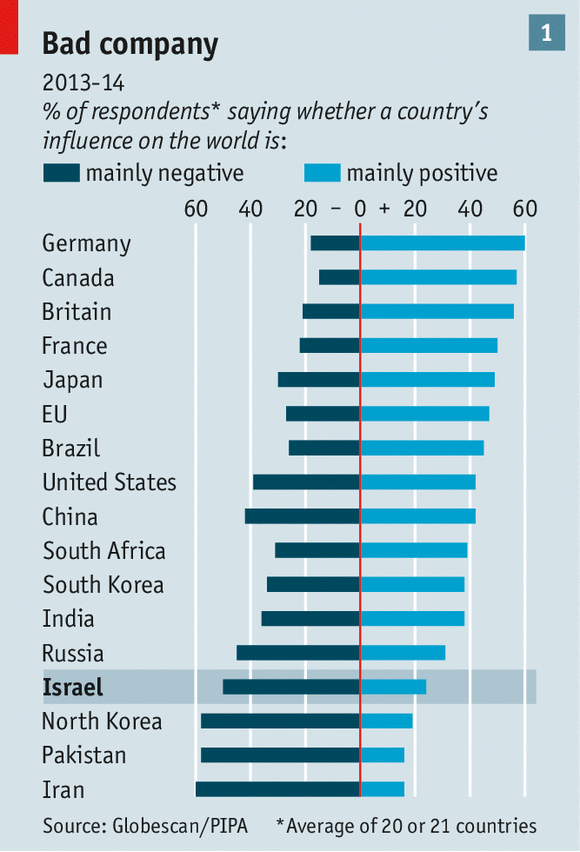
Israel and the world: Us and them | The Economist

Israel in World
Not encouraging:

Daphna Kaufman of Reut wonders whether Israel is also moving away from Europe. The secular and social-democratic leanings of Israel’s early decades dovetailed with western Europe’s. But the 1m migrants from the former Soviet Union, who arrived in the 1990s, have scant democratic tradition; many seek salvation in a strongman, a Jewish Putin, to rescue Israel from its enemies.

A similar number of national-religious Jews, heavily represented in government, see Israel as part of the divine plan for the Messiah’s coming, and worry that democracy might get in the way. More often now, Israel finds it easier to deal with non-democratic regimes, in the region or in the Asia-Pacific, where politics intrudes less on business. All of that bodes ill for co-operation with the country’s European critics and perhaps its American ones too.

Some hope that the common threat of a jihadist menace will yet induce Europe to treat Israel as its frontline bulwark and to overlook the plight of the Palestinians. “Ours is the fight of the free world,” says Mr Steinitz. But others see only greater divergence ahead. “Within 50 years, Europe’s lingua franca will be Arabic, and Britain will have a Muslim majority,” Moshe Feiglin, a hardline member of Mr Netanyahu’s party, Likud, tells a nodding audience in Bet Shemesh, a commuter town between Jerusalem and Tel Aviv. His listeners see a future in which Israel is increasingly forced to rely on its own devices—and its own might.

Haven’t seen any recent Canadian polling on attitudes with respect to Israel and Palestine.

Israel and the world: Us and them | The Economist.

John Rainford: Adapting to cultural norms before treating deadly diseases

Vignette on cultural adaptation and being sensitive to local traditions in the current Ebola crisis:

Consistent with protocols, the WHO experts had been dressing in their protective gear prior to arriving at the village. It covered their faces, their hands, which immediately raised suspicions. The equipment was white, culturally associated with the supernatural, which further raised concerns.

Exposure to victims was known to be the primary way in which the disease spread and so guidance was issued not to touch the dead and to bury them immediately. This flew in the face of local traditions whereby the dead were surrounded by loved ones until their souls passed into the next world.

Isolation hospitals had been established and – following best practice — the sick were whisked away from their families into the facilities. Of course, few ever came back. Villagers never saw their loved ones again and suspected the foreigners were to blame.

So the GOARN team adapted — they had little choice. With no real treatment beyond supportive care, the key intervention would be behavioural change. The experts could have all the qualifications in the world, but if their advice was ignored, more people would die.

Teams began suiting up in their protective equipment only after arriving at the villages and learned local greetings to help rebuild trust. They worked with religious leaders to modify burial customs to minimize the threat of infection. They lowered barriers surrounding the isolation hospitals so family members could see those inside a send a simple, but essential message: “we have not abandoned you”.

National Post | Full Comment » Full….

Residents urged to apply for Canadian citizenship to avoid hurdles on horizon

Nicholas Keung’s story on the coming-into-force provisions of C-24 Citizenship Act, and some concrete stories about some who will be affected:

When Ottawa enacted the new law in June, many, including frontline immigrant settlement workers, assumed it would take effect immediately and that little could be done to beat its more restrictive criteria.

In fact, some of the most controversial changes — requiring citizenship applicants to be present in Canada for four years out of six rather than three years out of four, and raising the age of exemption from language and citizenship tests to 65, from 55 — won’t come into force until next June, immigration officials confirmed to the Star.

“We want to tell people it’s not too late, and they should take advantage of the old rules,” said Ann McRae, executive director of the Rexdale legal clinic, a member of the Inter-Clinic Immigration Working Group.

At the South Asian Legal Clinic of Ontario, staff have reached out to community groups to deliver workshops and help clients file citizenship applications.

“All the changes were rushed through so quickly that people are confused,” said clinic lawyer Karin Baqi. “Those who are eligible today may not be eligible tomorrow. We have to get the word out.”

Remon Kirkor came here from Iraq with his wife and three daughters in 2007. The family met the three-year residence requirement in 2010. Yet, Kirkor, 44, hasn’t applied for citizenship, because he knows that as a high school dropout he would have a tough time passing the language test or the citizenship knowledge exam offered only in English and French.

“I work 20 hours a day to support my family. By day, I am a window installer. At night, I work as a dishwasher,” Kirkor, a former truck driver for UNICEF, said through his daughter, Mariam. “I have no time to sleep. I have no time to study English.”

Residents urged to apply for Canadian citizenship to avoid hurdles on horizon | Toronto Star.

Cancer fight puts focus on lack of minorities on stem-cell donor lists

Periodically, articles emerge regarding the need for more donors from minority communities (e.g., Asian British Columbians less likely to be organ donors). This latest, thanks to a social media campaign launched by Mai Duong, a leukaemia patient in Montreal, pertains to the need for stem cell donations, used to transplant new immune systems to patients with a range of blood-related cancers.

Having benefitted from a stem cell donation to treat my lymphoma, and without the challenges of finding a donor given my European ancestry (my donor turned out to be a nice young German man), I can only urge those of you of whatever extraction to consider donating stem cells. The Canadian link is OneMatch Stem Cell and Marrow Network, in Quebec, Héma-Québec:

But Duong, 34, has discovered that locating the right person can be a needle-in-a-haystack challenge, particularly for those who are from a non-Caucasian background.

“This is a global problem,” Duong, who is of Vietnamese origin, said in an interview from her room at Montreal’s Maisonneuve-Rosemont Hospital.

“We can’t do a scavenger hunt every time someone has this type of problem.”

…. Canada Blood Services, which manages the stem cell and marrow registry outside Quebec, says 340,837 people are currently registered in the rest of the country. Of them, 71 per cent are Caucasian, with the rest qualifying as “ethnically diverse” or of unknown origin.

Hema-Quebec, the organization that manages the province’s list, says about three per cent of the 47,000 stem-cell donors are of Asian descent and only a fraction of those are Vietnamese. The ratios are similar among international donors and Vietnam doesn’t have a registry of its own.

Cancer fight puts focus on lack of minorities on stem-cell donor lists.

Ethically speaking: Discuss communication issues around accents with respect | Toronto Star

Some good practical advice when you can’t understand some accents and how to raise your concerns:

Carefully. Very, very carefully.

I like the way you’ve framed the problem. Rather than launching into a racist diatribe about “foreigners who won’t even speak Canadian,” you’ve set the issue up in a way that is reasonable and respectful. You’ve tried, but remain frustrated by an inability to communicate with the folks behind the counter.

I suggest that you speak to the owners quietly, when there are no other customers in the store. Describe your concern exactly as you’ve told it to me. Make sure they understand how great you think their store is, and how much you want them to succeed. And leave it to them to act however they think is appropriate.

The version of your problem that is more difficult is the one where you phone a customer service centre — say for Bell, Rogers or whomever — and get an agent whose accent is so thick you can’t understand it. For many people, especially those whose hearing is less than 100 per cent, this is very frustrating. They’ve waited 30 minutes on hold “your call is important to us”; now they’re trying to explain their problem to someone they simply cannot understand.

Ethically speaking: Discuss communication issues around accents with respect | Toronto Star.