Shopping for Votes by Susan Delacourt

Shopping for Votes provides a good overview of how politics has become more sophisticated in marketing approaches, and how this sophistication has increased over time. Some observations:

  • A large part of her thesis concerns the shift from viewing voters as citizens to viewing them as consumers, and the implications this has for policy (more “what’s in it for me” than what was viewed to be in the national interest, e.g., Mulroney govt initiatives like the FTA or GST). In one sense, this intrinsically plays into a more conservative agenda, as consumer/taxpayers will prefer lower taxes and be more critical of government services. It is harder to develop equally sharp messaging on the value of government services than more money in people’s pockets.
  • Political parties are more sophisticated in their understanding of voters than is the public service, given their incredibly developed polling and social science understanding of what motivates people. This knowledge is centralized, as is party messaging, and further contributes to a reduced role for MPs given that the parties have more knowledge about voters than local MPs. As public service polling and other research spending has decreased, and is largely at the macro big picture level, political parties have a more granular and targeted understanding. Public service advice has to consider all Canadians; increasingly political parties are focused on their base and potential growth of their base.
  • Highly ironic that the Conservative Party, justifiably criticized for their rejection of social science and other evidence-based policy making, has the most sophisticated social policy, behavioural research and polling to further their electoral objectives. What is effectively used  in the pursuit of power, is often rejected  in the exercise of power.

Well worth reading.
Citizenship Legislation Pre-Messaging

Starting with an interview with Citizenship and Immigration Minister Alexander, he confirms his focus will be on implementation of policy changes of Minister Kenney, with the exception of citizenship legislation, developed largely during Minister Kenney’s time, will be stickhandled through Parliament by Minister Alexander.

Promise of lower wait times and backlogs should be matched by better performance information and service standards, publicly available on a quarterly basis (i.e., not requiring ATIP requests), to ensure accountability.

Immigration Minister Chris Alexander promises lower wait times, fewer backlogs in 2014.

And pre-messaging on the upcoming changes to the Citizenship Act suggest the following elements:

  • Longer residency requirements (currently three years, four to six years floated);
  • No longer granting citizenship based upon place of birth (jus soli);
  • Fast tracking citizenship from applicants from the Canadian forces (USA has similar provision);
  • Possible improved citizenship processing compared to current 2 year processing times;
  • Possible additional measures to address the remaining “Lost Canadians” for people caught without citizenship given their circumstances before 1947 when Canadian citizenship was instituted;
  • Whether the government will revisit the second generation limit (it has signalled in the past that it will do so for crown servants working abroad).

As Canadian citizenship rules face an overhaul by the Harper government in 2014, here’s what to expect

Similar to my own list in The citizenship review: what to watch for (which included more “housekeeping” measures) but we shall see exactly what is in and what is out once the Bill is tabled.

Apologie de la charte autour d’une dinde | Le Devoir

While this is fairly standard stuff for political parties to do for controversial initiatives, the responses indicate just how much the PQ government is digging in to the identity politics behind the Charter:

De même, si la parenté s’inquiète parce qu’on « passe pour des racistes partout dans le monde », il serait bien de répondre que « c’est faux ! », conseille le PQ. « Nous sommes loin d’être les premiers à vouloir affirmer la séparation des religions et de l’État », dit-on en parlant des cas de la France, de la Belgique et de l’Allemagne.

On propose aussi des réponses possibles si quelqu’un dit que « la charte, ça fait juste diviser tout le monde ». Le PQ suggère de répondre qu’au « moment de son adoption, la loi 101 a été décriée par plusieurs » et qu’elle fait aujourd’hui objet d’un consensus. La « charte des valeurs québécoises [le premier nom de ce qui est devenu la « Charte affirmant les valeurs de laïcité et de neutralité religieuse de l’État ainsi que d’égalité entre les femmes et les hommes et encadrant les demandes d’accommodement »] s’inspire de la même logique », dit-on.

—–

Since it was unveiled by the PQ government of Pauline Marois this year, the Charter has proven so divisive that most Quebec families would probably choose to talk about anything else at festive gatherings. As a general rule, politics and religion are off the table at Christmastime.

However, the party thought it would be a good idea to arm its members with ready arguments in case the hot topic comes up. Sylvain Tanguay, the director general of the PQ, said in an interview on Tuesday that the holiday guide was emailed to more than 10,000 members last Friday.

“It’s simply a synthesis of all the arguments and questions that came up during the fall,” Mr. Tanguay said. He referred to it as an end-of-year “memory aid” and said it was penned by the party’s communications team in Montreal.

The guide’s talking points unwittingly expose all the targets of the Charter’s many critics. For example, the document says that if a family member asks: “Why ban religious signs for all State employees?” the respondent should say that civil servants are already prevented from displaying their political views on the job (it does not mention that political allegiances are a choice, unlike religious affiliations).

Apologie de la charte autour d’une dinde | Le Devoir.

PQ releases self-help holiday guide to defending Quebec values charter

Talking points for the PQ faithful

The hearings on the Charter start 14 January with some 200 submissions, meaning that the hearings will last up to three months. It will be interesting to see how the balance of views compares to the Bouchard-Taylor Commission, with the additional difference that it will be the PQ government pressing ahead rather than independent commissioners writing a report:

Charte: au moins 200 heures d’audiences

Le vrai débat sur la laïcité débutera le 14 janvier | Politique québécoise

And from the academics, 60 professors, including many of the leading experts on diversity-related issues (e.g., Jocelyn Maclure, Daniel Weinstock). Of particular interest is the response to Roger Tassé, one of the federal officials involved in the drafting of the Canadian Charter of Rights and Freedoms:

« Je [Sébastien Grammond] comprends que Roger Tassé puisse dire que les tribunaux ont interprété la Charte différemment de ce qu’il avait pensé à l’époque. Mais un texte juridique, c’est comme un texte littéraire : une fois qu’il est écrit, l’auteur en perd le contrôle », ajoute le professeur.

Soixante professeurs contre la Charte

La Géographie du Canada et de sa diversité culturelle

This French website, developed by Dennis Fox, a Canadian professor at the Université de Nice, is a good reference site in French about Canada and Canadian diversity. I was interviewed a number of years ago by Professor Fox (see Entretiens vidéos avec des experts for short clips) as part of his developing the site (disclosure: he is a friend of mine). Good to have a more balanced portrayal of Canadian multiculturalism in France, given their very different model of laicité and poor record of integration.

La Géographie du Canada et sa diversité culturelle

Direct links to the clips:

Andrew Griffith: Quelle relation entre les peuples autochtones et le multiculturalisme au Canada ?

Andrew Griffith: Qu’est-ce qui fait le ciment canadien et la nature de l’identité canadienne?

Andrew Griffith: Est-ce qu’il y a des régions du monde qui sont favorisées dans …

Andrew Griffith: Est-ce que la politique de multiculturalisme a contribué à l’identité canadienne?

Andrew Griffith: Quelle est la faiblesse du multiculturalisme canadien ?

Andrew Griffith: Quelle est la force principale du multiculturalisme canadien ?

Andrew Griffith: Quel est l’obstacle le plus important à l’intégration économique des immigrants ?

Policy Arrogance or Innocent Bias – Update

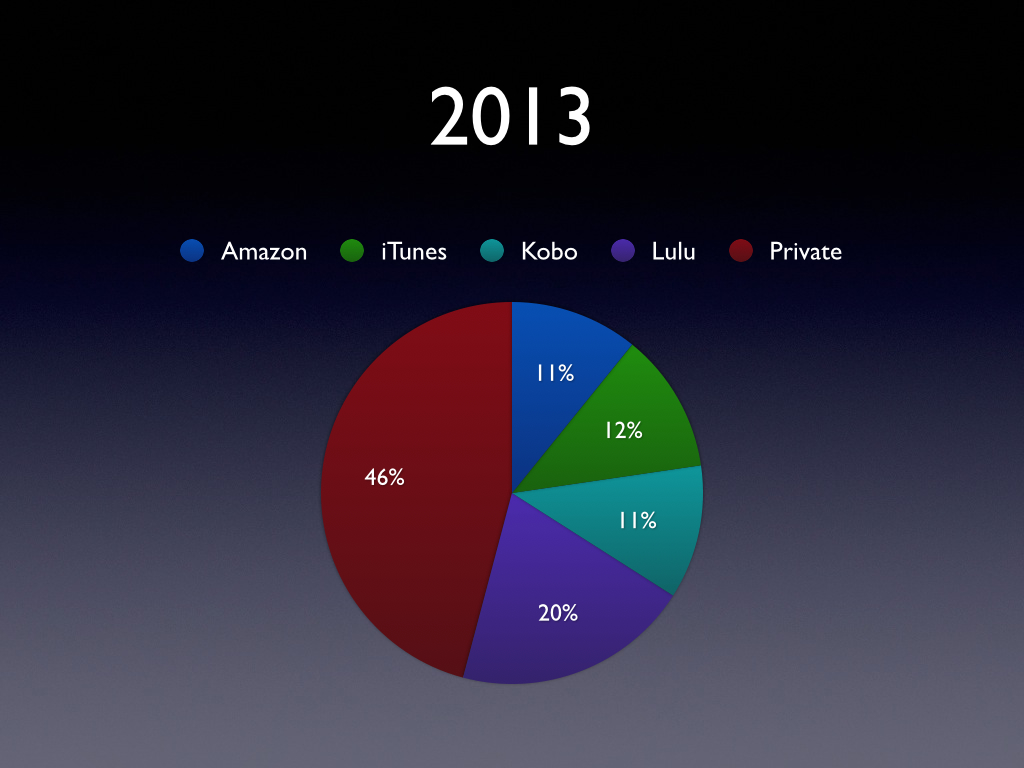
For those interested, the chart below provides a breakdown by sales by channel. Interestingly, the paper version is favoured by two-thirds, with close to half of total sales coming from private or direct sales. The electronic versions seem to sell equally well, whether through Amazon, iTunes, or Kobo.

By Sales Channel

By Sales Channel

Sold over 200 copies, less than I had hoped, but distributed close to an additional 100 copies for review and other purposes, generating good media coverage and interest, and generating some conversation on the relationship between the government and the public service. Given that direct or private sales seem to be the most effective, will be focussing on opportunities (e.g., speaking engagements, op-eds and the like) to increase interest.

In terms of blog stats, the top 10 posts (apart from Home Page and About) are focussed on my book and secondarily, on the Quebec Values Charter:

  1. Policy Arrogance or Innocent Bias: Resetting Citizenship and Multiculturalism (book splash page)
  2. News Release – Policy Arrogance or Innocent Bias: Resetting Citizenship and Multiculturalism
  3. Former CIC mandarin says several public policies came from minister’s anecdotes | hilltimes.com
  4. ATIP Documents
  5. Gilles Paquet’s Critique of Policy Arrogance or Innocent Bias
  6. Case study highlights conflict between bureaucrats, Minister Kenney on direction of multiculturalism programs – The Globe and Mail
  7. The citizenship review: what to watch for | iPolitics
  8. Charte des valeurs québécoises: Articles
  9. Quebec’s “war” on religion – Charter Round-Up
  10. Abuse of language that keeps going forward – FT.com