Les femmes voilées sont «manipulées», dit Janette Bertrand

Some more articles on the Quebec values charter, starting with the assumption that all women who wear the hijab are manipulated (like all men who wear the kippa or turban or muslim head covering, presumably).

From the “Yvettes” of the 1980 referendum to the “Janettes” of today, the same arrogance, assumptions and insularity about others, the same transposition of the Quebec francophone experience of the 50s to today, and the same lack of appreciation of the complexity of the human condition.

Les femmes voilées sont «manipulées», dit Janette Bertrand | KATIA GAGNON | Actualités.

A nice vignette about the practicalities of the proposed Charter – Quebec does not have an accurate idea of how many public servants (core government, not sectors like health, education etc.) would be affected by the Charter, using the number that serve the public as a criteria. And as usual, Minister Drainville doesn’t see a problem:

Québec ignore le nombre de fonctionnaires qui travaillent avec le public

And no surprise, the latest group to criticize the Charter, this time mental health professionals:

Quebec charter of values slammed by mental-health professionals
Migration – The Example of Portugal

A nice overview of Portuguese migration, and how Portuguese migrants have managed to preserve their culture while successfully integrating into their host society. And yet another illustration of how identities are complex and varied, and don’t neatly fit into some of the citizenship categories and identities that we try to make:

“If the emigrant is a vehicle through which the Portuguese can think about their attachment to their homeland,  if the emigrant is a vehicle though which the Portuguese can find their roots in their past, if the emigrant is a vehicle through which the Portuguese can represent their ecumenical and tolerant spirit, then the emigrant is also a vehicle for the expression of greatness – for the extension of thought beyond the boundaries of a small country wedged between Spain and the Atlantic Ocean at the very edge of Europe.  The emigrant unbinds the Portuguese nation and Portuguese culture.”

A Culture of Migration

Proposed Toronto police reforms to ‘carding’ don’t go far enough

An illustration of racial profiling by the Toronto Police, using “contact cards” (no charges were laid) which disproportionately included young black males. And like all monitoring systems, officers who fill out more cards are rewarded more than others who do not, without any analysis of potential bias.

Proposed Toronto police reforms to ‘carding’ don’t go far enough: Editorial | Toronto Star.

Charte des valeurs: Québec songe à exclure la santé

Behind all the official reasons cited, there must be fear of losing qualified personnel. But if an exception for healthcare, why not for daycare or education?

Charte des valeurs: Québec songe à exclure la santé | Denis Lessard | Politique québécoise.

‘Exceedingly political’ libel case pits free speech advocate Ezra Levant against ‘master of lawfare’

Yet another libel case against Ezra Levant for comments he made against a Muslim Canadian lawyer. While I am not a fan of much of Ezra’s commentary (he has a tendency towards “jihad” against anyone who he disagrees with), these kinds of debates and controversies are best handled in the court of public opinion rather than be the courts.

‘Exceedingly political’ libel case pits free speech advocate Ezra Levant against ‘master of lawfare’ | National Post.

Longtime resident seeking citizenship hits bureaucratic wall

Another illustration of just how broken the citizenship program is. Common sense should have prevailed. And why officials don’t think things through and require people to go public. After all, when once they do, the bureaucracy has to move in any case.

Longtime resident seeking citizenship hits bureaucratic wall – British Columbia – CBC News.

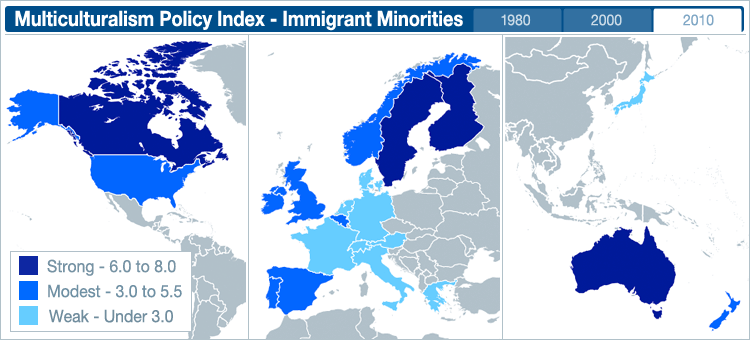
Multiculturalism Policies in Contemporary Democracies

Map2010The comparative work by Keith Banting and Will Kymlicka of Queen’s University. A wealth of detailed and general information in this site.

Expect that Australia’s score will change following the change in government.

Multiculturalism Policies in Contemporary Democracies – Home.

Canadian Muslims encounter increasing hostility

Haroon Siddiqui of The Star on polls showing different levels of distrust for different ethnic and religious communities, similar to the earlier poll posted on BC attitudes (British Columbians grow more wary of other religions, interfaith marriages).

While some of this is normal (negative attitudes tend to prevail regarding more recent communities), the gaps are still startling.

We didn’t have such polls 50 years ago when the minorities that were likely viewed with suspicion included Jewish Canadians, Italian Canadians and the like.

Canadian Muslims encounter increasing hostility: Siddiqui | Toronto Star.

Slow the flow of immigrants into Canada

Martin Collacott on immigrant selection and quantity. Collacott has a point in that there never has been, to my knowledge, an analysis of what should be the appropriate level of immigration to Canada; the government just sticks with the current levels.

The temptation to select immigrants on the basis of their ability to integrate, once one gets beyond the basics of language and professional competencies, becomes subjective all too quickly, and subject to potential abuse, as a history of previous immigration restrictions illustrates.

Guest column: Slow the flow of immigrants into Canada

Embassy Magazine List of Top Reads – Policy Arrogance or Innocent Bias

Made the list (under books for Policy Wonks)!

Policy Arrogance or Innocent Bias: Resetting Citizenship and Multiculturalism

Andrew Griffith

Anar Press

Sept. 8, 2013

This former director general responsible for the federal government’s multiculturalism portfolio gives readers a glimpse into the sometimes uncomfortable gap between public service expertise and ministerial direction. Mr. Griffith says he witnessed a fundamental reset of multiculturalism policies and programs between 2007 and 2011 under Jason Kenney’s direction (who was first secretary of state and then minister responsible for the file). “Given the sharp nature of the policy reset, and the entrenched views of many public servants, this book aims to provide a small case study of how public servants adjusted to the new reality—one in which their expertise was fundamentally challenged, discounted, and at times ignored,” he writes. Mr. Griffith’s book is making waves in the Ottawa bubble.

http://www.embassynews.ca/top-foreign-policy-books/2013/10/09/insightful–international-reads-of-2013/44604?page_requested=1